Three practical tasks. One professional approach.
The revision guide sets out three practical tests: assess crops on a crop walk, set and monitor machinery for a defined task, and maintain non-productive areas. Work to the site-specific instructions on assessment day. For every task, plan safely, explain why you make decisions, monitor the result and keep accurate records.
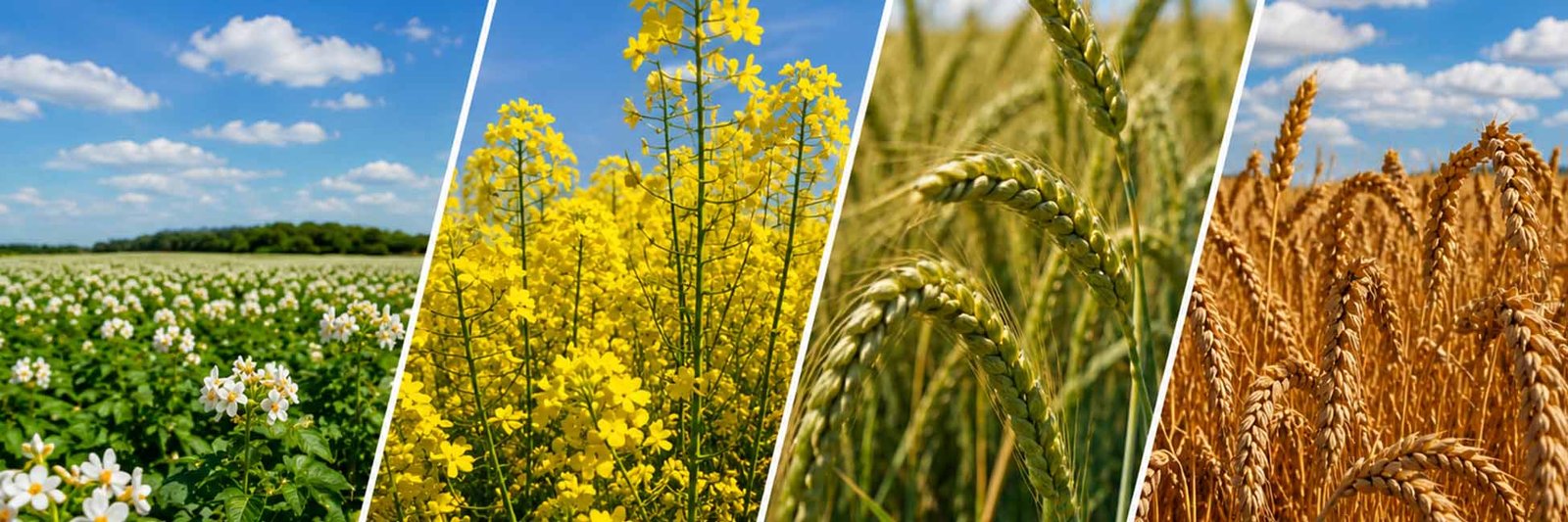
Task 1 — Assess crops on a crop walkCrop quality, performance, soil condition and requirements
Task brief: Assess crop quality, performance and requirements during a representative crop walk. Describe what you observe, record evidence and recommend justified actions relevant to the crop and business.
Prepare, observe and record
- Confirm permissions, PPE and the site-specific risk assessment; take a field map and suitable recording tools.
- Plan a representative route (for example, a W-shaped transect in a large field) and note variation and outliers.
- Assess establishment, plant population, gaps and crop-specific growth stage; use the appropriate growth-stage scale.
- Inspect crop and canopy health; distinguish possible nutrient symptoms, frost or scorch and explain what evidence you would check.
- Identify weeds, pests and diseases; note their distribution and severity and relate monitoring to IPM thresholds.
- Check soil moisture, structure, compaction, crusting, residue, erosion, waterlogging and buffer zones where relevant.
- Assess relevant quality indicators, such as grain fill, size, colour or contaminants, against the specification.
- Record observations and measurements; recommend proportionate actions with reasons, timings and follow-up checks.
What strong evidence looks like
Pass: Assess and monitor crops for quality, performance and business specification; use accurate, legally compliant records; work safely and follow hygiene and biosecurity practices.
Distinction: Assess thoroughly and efficiently to maintain optimum quality standards, and justify how your actions optimise crop growth and economic sustainability within environmental requirements.
Watch for: making a recommendation from one isolated observation, identifying a symptom without checking its cause, or failing to record evidence and explain the next step.
Task 2 — Set and monitor machineryA defined task, correct settings and crop/soil conditions
Task brief: Set up machinery and monitor its performance for a defined task. The guide notes that a task may be simulated when the season, crop need or conditions make live work unsuitable; follow the assessor’s direction and explain the procedure as you demonstrate it.
Plan, set, operate and review
- Confirm operator competence, task requirements, manufacturer instructions and relevant risk controls before starting.
- Carry out and record pre-start checks: guards, PTO, oil, hydraulics, tyres, lights, brakes, hitch pins and visible damage.
- Match machine and settings to the crop, task, soil and specification; explain depth, speed, tyre width/pressure, ballast or seed rate as relevant.
- Calibrate seeders, sprayers or spreaders where relevant; show the target, calculation, test and recorded rate.
- Operate safely and monitor output, sample rows, work depth, finish, overlap/drift, wheelings and soil condition as appropriate.
- Make and explain adjustments when crop, soil or weather conditions change; stop and seek advice if the task becomes unsafe.
- Clean, maintain and store equipment correctly; complete records and note any damage or follow-up action.
What strong evidence looks like
Pass: Operate and maintain machinery safely in accordance with manufacturer instructions, set equipment for the task and conditions, and demonstrate how you monitor performance.
Distinction: Set up efficiently and justify how the settings create optimum conditions for crop establishment and growth while reducing avoidable soil damage.
Watch for: treating checks as a memory list without explaining the actual machine, skipping calibration, or continuing when conditions make the operation unsafe or damaging.
Task 3 — Maintain non-productive areasField margins, tracks, gateways, storage surrounds and scheme areas
Task brief: Maintain a non-productive area and explain how the work supports environmental schemes, safety, biosecurity, biodiversity or machinery access. The guide expects environmental schemes to be a key focus.
Check and carry out the work
- Confirm the purpose, boundaries, permissions, scheme requirements and site-specific risks before work.
- Check for utilities, protected species, nesting restrictions, watercourses and relevant environmental codes.
- Choose suitable tools and timing; protect margins, roots, soil structure and adjacent crops from unnecessary damage.
- Maintain access, gateways, tracks, drainage, fences, gates, signs or storage areas as required by the task.
- Manage vegetation and waste responsibly, including invasive weeds and biosecurity controls where relevant.
- Explain how the work supports biodiversity, soil and water protection, safe access or an agreed environmental scheme action.
- Record the work and review whether the area meets the intended condition and needs further attention.
Environmental scheme revision
Be ready to describe relevant actions and their purpose. The guide highlights the Sustainable Farming Incentive (SFI), Countryside Stewardship and Landscape Recovery, with examples such as soil testing, cover crops, IPM, hedgerow management, field margins, buffer strips and habitat creation.
Pass: Demonstrate how to maintain non-productive areas and follow the relevant environmental, health and safety, hygiene and organisational requirements.
Distinction: Justify how your approach supports environmental aims and an effective, sustainable operation.
Watch for: assuming every scheme option applies at every site. Explain the agreement or instruction relevant to your workplace and verify current requirements with your employer.
Quick-fire practical self-check
Choose an answer for each question, then check your score. Use missed answers to choose what to revise next.
A simple approach for every task
Plan: purpose, people, equipment and risks. Do: work safely, follow instructions and communicate. Check: crop, output, soil and environmental impact. Record: evidence, decisions and follow-up. Be ready to explain why your approach suited the actual conditions.