
🚜 GFW Revision Hub
➜ What you need to know for exam 🔗
➜ Bank of questions (reset & retry) 🔗
➜ EPA practical hints & tips 🔗
➜ All you need to know 🔗
Guide to Revising
Revision – funnel your knowledge…
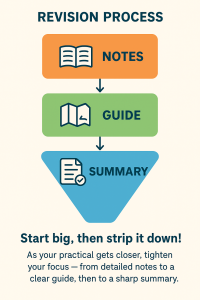
🧠 “Build your revision like a funnel — start wide with full notes, narrow it down to a clear guide, then finish with a short summary to keep the key points sharp for your practical.”
Revision process
🛠️ PREP STAGE – NOTES
Collect everything you need.
💡 BOOST STAGE – GUIDE
Streamline what matters.
🎯 LAUNCH STAGE – SUMMARY
Focus on the essentials for your practical.
In farming terms….
“Grow your knowledge, harvest your confidence!”
🌱 Notes – Sowing ideas
🌾 Guide – Growing understanding
🚜 Summary – Harvesting key points
GFW Exam Revision Notes 🧠 🐄 🐂 🐖 🐑🌾 🚜
⚠️ Health & Safety (Core Knowledge + Law)
Key Concepts
- Hazard = something that can cause harm (e.g. PTO shaft)
- Risk = chance + severity of harm
Hierarchy of Control (know the order)
- Eliminate → remove hazard completely
- Reduce → safer alternative
- Isolate → guards/barriers
- PPE → last line (gloves, goggles)
👉 Exam trap: PPE is not the first control
⚠️ Key Machinery Laws
Provision and Use of Work Equipment Regulations 1998 (PUWER)
What it means:
- Equipment must be safe, suitable, and maintained
- Only trained/competent people should use machinery
- Safety devices (guards, shields) must be in place
👉 Typical exam question: “What is required before using machinery?” ✔️ Correct answer = trained + equipment safe
🛠 Health and Safety at Work Act 1974 HASWA
What it means:
- Employer must provide:
- Training
- Safe systems of work
- PPE
- Employee must:
- Follow instructions
- Take reasonable care
👉 Exam trap: Responsibility is both employer AND employee
🚛 Road Use (Tractors & Trailers) Road Traffic Act 1988
What it means:
- Vehicles must be:
- Roadworthy
- Properly maintained
- Loads must be:
- Secure
- Not dangerous
👉 Examples:
- Loose bale = illegal
- Faulty lights = illegal
🔧 Lifting Operations and Lifting Equipment Regulations 1998 (LOLER)
What it means:
- Lifting equipment must be:
- Regularly inspected
- Used safely
- Loads must be stable and secure
👉 Exam angle: Overloading or unstable loads = illegal + dangerous
⚡ PPE Requirements – Personal Protective Equipment at Work Regulations 1992
What it means:
- PPE must be:
- Provided
- Suitable
- Used correctly
👉 Examples:
- Ear defenders (machinery noise)
- Gloves (chemicals)
👉 Exam trap: PPE is last line of defence, not first
Control of Substances Hazardous to Health Regulations 2002 (COSHH)
🧪 Chemicals & Spraying Equipment
What it means:
- Assess risks from chemicals
- Use PPE
- Store and handle safely
👉 Example: Sprayer use without PPE = illegal
🔍 Daily Checks & Maintenance (Legal Expectation)
Linked to:
- Provision and Use of Work Equipment Regulations 1998 (PUWER)
Must check:
- Oil, coolant
- Tyres
- Lights
- Guards
👉 Exam angle: Using faulty equipment = breaking the law
🧠 How to Remember Machinery Laws (Without Losing the Will to Live)
🔑 1. The “Big 5” Memory Hack
Forget trying to remember everything — drill this:
PUWER – LOLER – HSW – RTA – COSHH
👉 Turn it into something memorable:
“Please Lift Heavy Rough Concrete Safely”
- P → Provision and Use of Work Equipment Regulations 1998
- L → Lifting Operations and Lifting Equipment Regulations 1998
- H → Health and Safety at Work Act 1974
- R → Road Traffic Act 1988
- C → Control of Substances Hazardous to Health Regulations 2002
👉 They don’t need perfect recall — just enough to recognise the correct option.
🚜 2. Match the Law to the Situation
Think like this:
| Situation | Law to Think Of |
| Using machinery | PUWER |
| Lifting loads | LOLER |
| General safety | HSW |
| On the road | RTA |
| Chemicals | COSHH |
👉 Exams are usually just this in disguise
🧩 3. The “What’s the Risk?” Trick
Instead of remembering laws, ask:
👉 “What could go wrong here?”
- Machine breaks → PUWER
- Load falls → LOLER
- Chemical burns → COSHH
- Crash on road → RTA
👉 Brain links risk → law automatically
⚠️ 4. The “3 Always Rules”
If they forget everything else, remember this:
SAFE – TRAINED – MAINTAINED
Every correct answer usually includes one of these:
- Safe system
- Trained operator
- Maintained equipment
👉 If an option ignores these → it’s probably wrong
🧴 Biosecurity
Key Actions
- Clean/disinfect boots
- Quarantine new animals
- Control visitors
👉 Prevents disease entering farm
Law Link
- Animal Health Act 1981
🚜 Machinery & Transport
Daily Checks
- Oil → prevents engine damage
- Tyres → safety + stability
- Lights → visibility
Safe Use
- No passengers unless seat
- Keep loads stable and secure
- Visibility – lights + clean windows
Laws
- Provision and Use of Work Equipment Regulations 1998 (PUWER)
- Road Traffic Act 1988
👉 Unsafe machinery use = legal offence
🛠 Maintenance
Why Important
- Reduces breakdowns
- Maintains efficiency
- Improves safety
👉 Example: Blunt blades → poor cut + higher fuel use
Law Link
- Provision and Use of Work Equipment Regulations 1998 (PUWER)
📋 Records & Medicines
Must Record
- Medicine used
- Animal treated
- Date + dosage
👉 Ensures traceability
Key Law
- Veterinary Medicines Regulations 2013
👉 Withdrawal periods:
- Prevent residues entering food chain
👉 Selling too early = illegal
🐄🐑🐖 Digestive Systems
Ruminants (Cattle & Sheep) 🐄🐑
- Rumen = fermentation vat (microbes break down fibre)
- Reticulum = traps foreign objects
- Omasum = absorbs water
- Abomasum = “true stomach” (acid digestion)
👉 Allows use of grass, silage, hay
Monogastric (Pigs) 🐖
- Simple stomach with acid digestion
- Limited fibre digestion → rely on concentrates
👉 Diet must be higher quality + more digestible
Law Link
Animal Feed Regulations 2010
- 👉 Feed must be:
- Safe
- Stored correctly
- Free from contamination
👶 Reproduction
Oestrus Cycle
| Animal | Cycle | Key Detail |
| Cow | 21 days | Short heat → easy to miss |
| Sheep | 17 days | Seasonal (autumn breeders) |
| Pig | 21 days | Long heat → easier detection |
Heat Signs
- Standing to be mounted (most reliable sign)
- Mounting others
- Increased activity
Gestation
| Animal | Gestation | Key Detail |
| Cow | 283 days | ~9 months |
| Sheep | 147 days | ~5 months |
| Pig | 115 days | 3-3-3 rule |
👉 EXAM trap: mixing up sheep and pigs
Law Link
Animal Welfare Act 2006
- 👉 Must:
- Monitor animals during birth
- Intervene if needed
- Provide clean environment
🐄🐑🐖 Youngstock
- Calf (cow)
- Lamb (sheep)
- Piglet (pig)
👉 Often appears as simple recall question
🐄 Animal Health
Key Signs
- Reduced intake → early illness indicator
- Lameness → pain/injury
- Isolation → stress/disease
- Discharge → infection
Species Differences
- Cattle → lameness common (foot issues)
- Sheep → flystrike risk in warm weather
- Pigs → respiratory disease in poor ventilation
Key Law
Animal Health Act 1981
👉 Gives government powers to control outbreaks
Notifiable Diseases
🐄 Cattle
- Bovine Tuberculosis (TB) → chronic disease, weight loss, coughing
- Brucellosis → abortion, fertility issues
- Anthrax → sudden death, very serious (also risk to humans)
🐑 Sheep & Goats
- Scrapie → nervous signs, itching, loss of coordination
- Bluetongue → swelling, lameness, ulcers (spread by midges)
🐖 Pigs
- African Swine Fever → severe, high mortality, no treatment
- Classical Swine Fever → fever, haemorrhages, very contagious
👉 Legal duty: report immediately
🧠If you suspect a notifiable disease:
- Report to employer / supervisor
- 🚫 Do NOT move animals
- 📞 Report immediately (APHA in the UK)
- 🧼 Lock down biosecurity
💧 Feeding & Water
Key Principles
- Water = most important nutrient
- Intake drops quickly if water unavailable
Feeding by Stage
- Young → protein (growth)
- Lactating → energy (milk production)
- Finishing → energy (weight gain)
👉 Poor feed = poor performance + welfare issue
Law Link
- Welfare of Farmed Animals Regulations 2007
👉 Requires:
- Adequate diet
- Constant access to clean water
❤️ Five Welfare Needs (LEGAL REQUIREMENT)
From:
- Animal Welfare Act 2006
Expanded
- Environment → shelter, dry bedding, ventilation
- Diet → correct nutrition + water
- Behaviour → ability to graze/root/move
- Social → correct grouping
- Protection → prompt treatment
👉 EXAM trap: missing one or adding a fake one
🐑 Livestock Handling
Principles
- Calm movement reduces stress hormones
- Stress reduces productivity and increases injury risk
Behaviour
- Sheep → follow flock instinct
- Cattle → move in groups, follow leader
- Pigs → dislike pressure, need guidance
Law Link
- Welfare of Farmed Animals Regulations 2007
👉 Handling must:
- Avoid injury
- Avoid unnecessary stress
🌾 Crops & Forage
Crop Specification
- Milling wheat → high protein for bread
- Malting barley → low nitrogen for brewing
👉 Quality affects price
Grassland
- Too short → weak regrowth (plant stressed)
- Too long → stemmy, low nutrition
Crop Problems
- Yellowing → nutrient deficiency (often nitrogen)
- Patchy growth → soil compaction/drainage
Law Link
- Environmental Protection Act 1990
👉 Illegal to:
- Pollute water
- Mismanage waste
🌍 Soil
Key Points
- pH affects nutrient availability
- Ideal pH ~6–7 (most crops)
- Lime raises pH
👉 Wet soil → compaction damage
♻️ Sustainability
Key Practices
- Crop rotation → reduces pests/disease
- Cover crops → protect soil
- Buffer strips → protect water
Scheme
- Environmental Land Management Scheme
👉 Pays farmers for environmental work