
Facts about Plant Varieties
- In agriculture, a variety is a plant of a given species that has been selected and cultivated, in order to produce specific characteristics which, meet man’s needs.
- Wheat for grinding into flour
- Barley for malt
- It is the same as a breed in livestock
- Aberdeen Angus for beef
- Holstein for milk
Harvesting Variety Plots

Quick Science facts:
| Plant Variety trials |
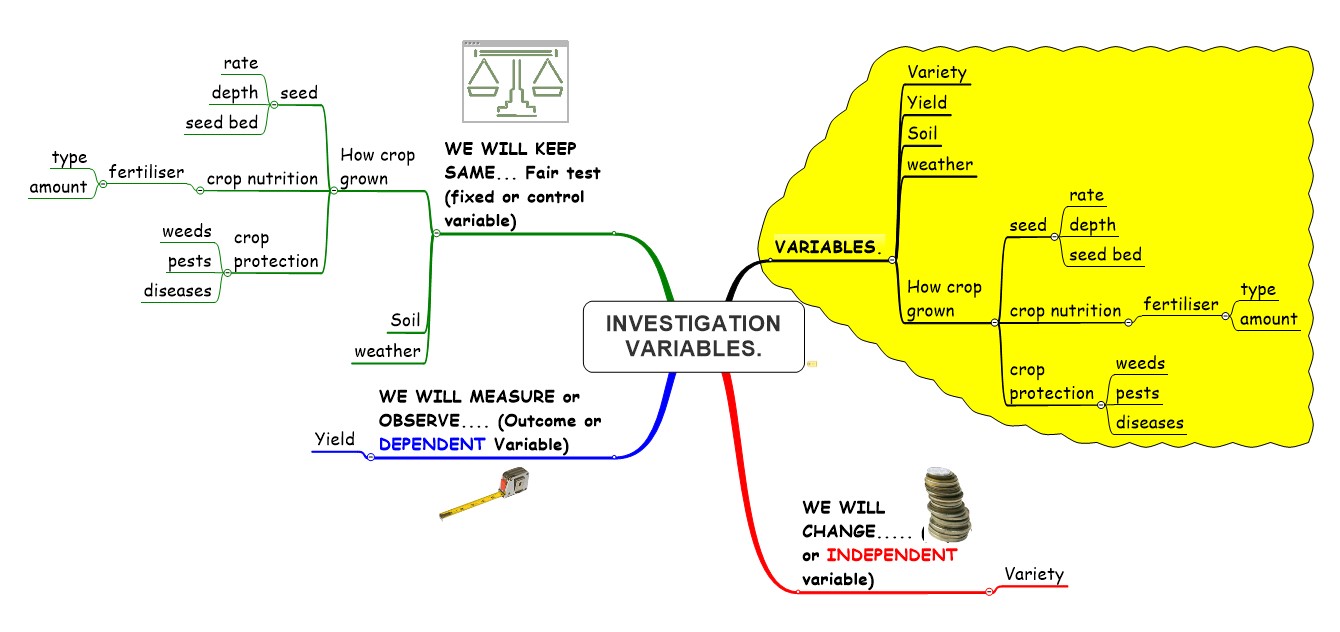
| These are proper science…. |
| Scientist want to find which variety is best. |
| Variety is the variable they want to change. |
| They want to measure the OUTPUT variable = YIELD |
| They need to make this a FAIR TEST by controlling the variables… |
| So they want to control all the INPUT or INDEPENDANT variable that could affect the yield: – Soil – Weather – How Planted – Fertiliser – Disease control |
| Part of doing this is to replicate there trials to allow for soil type, aspect etc |
| They then measure the OUTPUT or DEPENDANT variable = Yield |
Click image zoom
Plant Varieties and Integrated Crop Management (ICM)
🔍Click to zoom
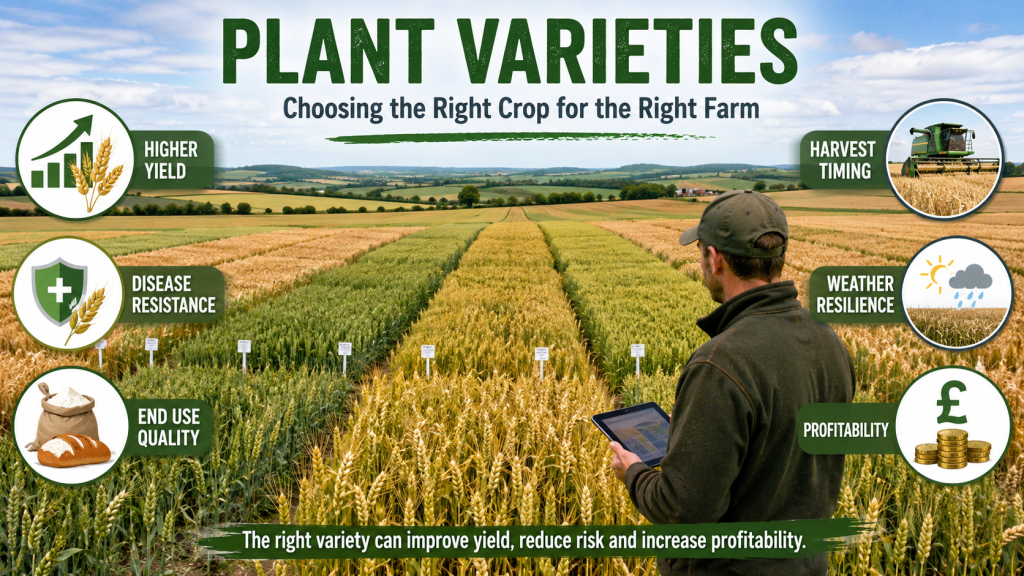
Choosing the right crop variety is one of the first and most important decisions a farmer makes. The variety selected can influence yield, quality, disease resistance, harvest timing, profitability and the amount of crop protection required throughout the growing season. Good variety selection is therefore a key part of Integrated Crop Management (ICM) and Integrated Pest Management (IPM) because it helps prevent problems before they occur rather than simply treating them afterwards.
What is a Plant Variety?
A plant variety is a cultivated form of a crop species that has been selectively bred to produce particular characteristics that meet the needs of farmers, processors and consumers.
Think of crop varieties in the same way as livestock breeds.
| Livestock | Crops |
|---|---|
| Aberdeen Angus – beef production | Skyfall – milling wheat |
| Holstein – milk production | RGT Wolverine – feed wheat |
| Texel – meat sheep | Laureate – malting barley |
Just as different cattle breeds are suited to different farming systems, different crop varieties are suited to different soils, climates, markets and management systems.
How New Varieties are Developed
New crop varieties are produced using selective breeding.
Plant breeders select parent plants with desirable characteristics, such as:
- High yield
- Disease resistance
- Better grain quality
- Improved standing ability
- Earlier maturity
- Better drought tolerance
- Resistance to lodging
These plants are crossed over many generations until a stable variety with the required characteristics is produced.
Unlike genetic modification, traditional selective breeding works by crossing plants that naturally belong to the same species.
Developing a new commercial variety can take 10–15 years before it reaches farmers.
Why Do Farmers Grow Different Varieties?
There is no single “best” variety for every farm.
Farmers choose varieties depending on:
- Intended end use
- Local climate
- Soil type
- Disease pressure
- Harvest timing
- Market requirements
- Previous cropping
- Rotation
- Machinery capacity
- Risk management
For example, one farm may grow:
- Group 1 milling wheat for bread making
- Group 4 feed wheat for livestock feed
- Winter barley for early harvest
- Spring barley for malting
- Oilseed rape with strong stem canker resistance
Growing several varieties spreads both workload and risk.
Variety Choice as Part of Integrated Crop Management (ICM)
🔍Click to zoom
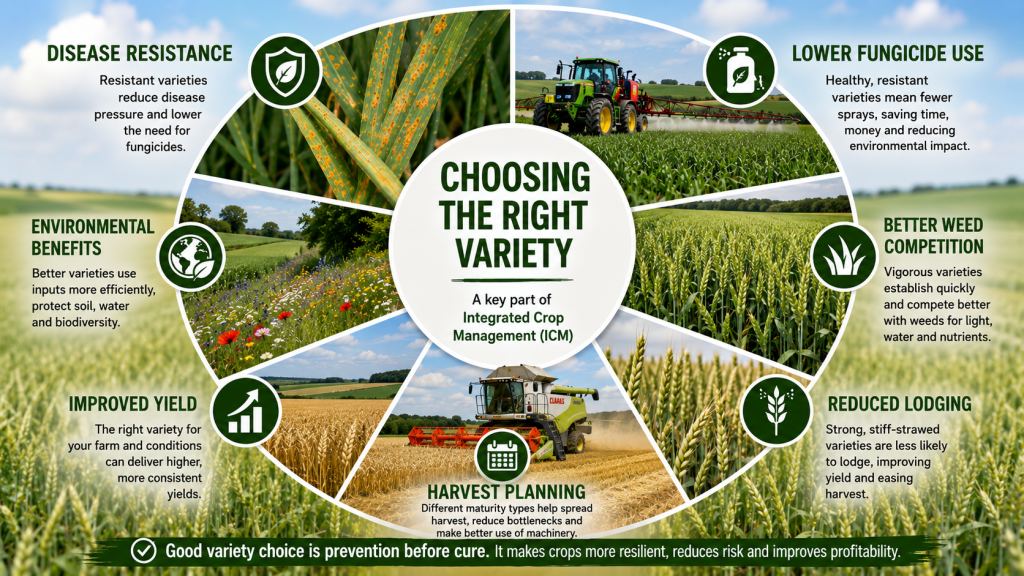
Integrated Crop Management aims to produce profitable crops while reducing unnecessary environmental impact.
Choosing the correct variety is a preventative cultural control, meaning it reduces problems before they develop.
Good variety selection can:
- Reduce disease pressure
- Lower fungicide use
- Improve crop competitiveness against weeds
- Reduce lodging
- Improve nutrient use efficiency
- Spread harvesting workload
- Increase resilience to weather
Rather than relying entirely on pesticides, farmers first select varieties that naturally perform well under local conditions.
Plant Varieties and Integrated Pest Management (IPM)
Integrated Pest Management follows the principle of prevention before cure.
Variety selection is one of the simplest ways of preventing pest and disease problems.
Examples include:
Disease-resistant varieties
Some wheat varieties have better resistance to:
- Yellow rust
- Brown rust
- Septoria tritici
- Powdery mildew
Growing resistant varieties reduces disease development and can reduce the number of fungicide applications required.
Pest tolerance
Some crop varieties tolerate insect damage better than others.
Examples include:
- Virus-resistant sugar beet
- Clubroot-resistant oilseed rape
- Potato varieties with resistance to potato cyst nematode
These varieties help reduce crop losses without relying solely on pesticides.
Weed competition
Some varieties establish rapidly and produce dense crop canopies.
These crops:
- Shade weeds earlier
- Compete better for light
- Reduce weed growth
- Improve herbicide performance
Variety Mixtures
Many farms grow several varieties of the same crop rather than relying on a single one.
For example, a farm may grow:
- An early-maturing wheat
- A later-maturing wheat
- A milling wheat
- A feed wheat
This helps to:
- Spread drilling dates
- Spread harvest
- Reduce weather risk
- Reduce disease risk
- Avoid all crops reaching maturity at the same time
Growing several varieties also prevents the whole crop being equally susceptible if one disease becomes severe.
Crop Variety Trials
Before a new variety is recommended to farmers it undergoes extensive independent testing.
Plant breeding companies produce thousands of experimental lines, but only a few eventually become commercial varieties.
Field trials compare varieties under identical growing conditions.
Scientists keep almost everything the same:
- Soil
- Fertiliser
- Drilling date
- Seed rate
- Crop protection
- Machinery
The only thing that changes is the variety.
This allows researchers to determine whether differences in yield are caused by genetics rather than other factors.
The Science Behind Variety Trials
Crop variety trials are examples of good scientific experiments.
Scientists identify three types of variables:
| Variable | Example |
|---|---|
| Independent variable | Crop variety |
| Dependent variable | Yield, quality or disease level |
| Controlled variables | Soil, fertiliser, weather (where possible), drilling date, seed rate and management |
By controlling all other variables, scientists can accurately compare the performance of different varieties.
Harvesting Trial Plots
Trial plots are harvested using specially designed plot combines.
Each plot is:
- Harvested separately
- Weighed accurately
- Moisture corrected
- Compared with every other variety
This provides reliable information on:
- Yield
- Grain quality
- Disease resistance
- Standing power
- Maturity
- Straw characteristics
Thousands of measurements are collected every year.
AHDB Recommended Lists
🔍Click to zoom
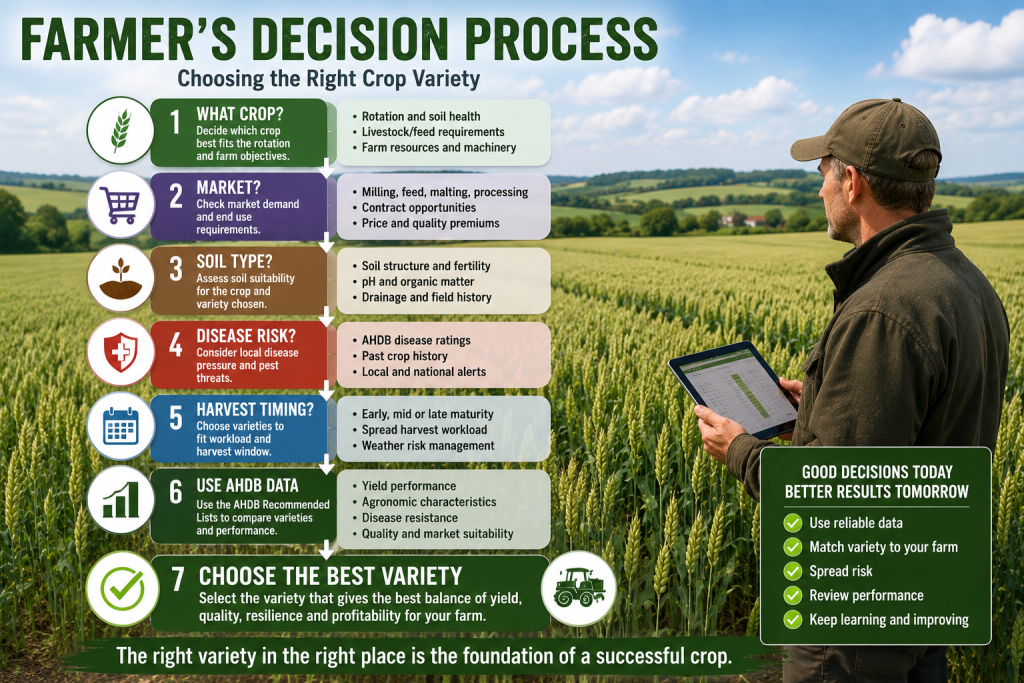
This list the choice of crop varieties to grown this is a process that includes various decision as shown in diagram above.
The AHDB Recommended Lists (RL) are one of the UK’s most trusted sources of independent variety information.
The lists compare varieties using data collected from trials across many locations over several years.
They include information on:
- Yield
- Disease resistance ratings
- Lodging resistance
- Grain quality
- Maturity
- Market suitability
- Agronomic characteristics
Most UK arable farmers use the Recommended Lists when deciding which varieties to grow.
Wheat Quality Groups
Not all wheat is suitable for the same purpose.
The UK classifies wheat into four main groups.
| Group | Main Use |
|---|---|
| Group 1 | Bread making (premium milling wheat) |
| Group 2 | Specialist milling wheat |
| Group 3 | Biscuits and soft flour |
| Group 4 | Animal feed |
Choosing the wrong variety could mean losing valuable quality premiums.
Variety Selection is Risk Management
No variety is perfect.
A farmer must balance several factors:
- Yield potential
- Disease resistance
- Grain quality
- Market demand
- Harvest date
- Local experience
- Soil suitability
- Weather risk
The highest-yielding variety may not be the most profitable if it requires expensive fungicide programmes or suffers severe disease.
Good variety selection aims to maximise whole-farm profitability rather than simply chasing the highest yield.
On-Farm Variety Trials
Many progressive farms carry out their own small-scale variety trials.
These might compare:
- Two wheat varieties
- Different barley varieties
- Potato varieties
- Seed rates
- Fertiliser programmes
- Fungicide strategies
By collecting data from their own fields, farmers can identify which varieties perform best under their local conditions.
This evidence helps improve future decision-making and supports continuous improvement within the business.
Key Points
- A plant variety is a cultivated form of a crop selected for particular characteristics.
- New varieties are developed through selective breeding.
- Different varieties suit different markets, soils and farming systems.
- Variety choice is a key preventative measure within Integrated Crop Management and Integrated Pest Management.
- Disease-resistant varieties can reduce pesticide use and improve crop resilience.
- Independent crop variety trials provide reliable scientific evidence on variety performance.
- The AHDB Recommended Lists help UK farmers choose the most suitable varieties for their farms.
- Growing a mix of varieties spreads harvest workload, reduces disease risk and improves resilience to changing weather conditions.
Below is presentation which gives more details about cereals grown in the UK.