
Guide to Revising
Revision – funnel your knowledge…
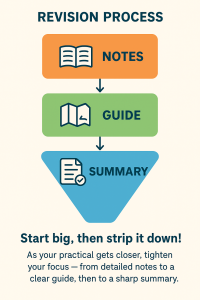
🧠 “Build your revision like a funnel — start wide with full notes, narrow it down to a clear guide, then finish with a short summary to keep the key points sharp for your practical.”
Revision process
🛠️ PREP STAGE – NOTES
Collect everything you need.
💡 BOOST STAGE – GUIDE
Streamline what matters.
🎯 LAUNCH STAGE – SUMMARY
Focus on the essentials for your practical.
In farming terms….
“Grow your knowledge, harvest your confidence!”
🌱 Notes – Sowing ideas
🌾 Guide – Growing understanding
🚜 Summary – Harvesting key points
Downloads
General Farm Worker Revision Tasks
Knowledge Revision – go to now
General Farm Worker Practice Questions
Practice Questions – go to now
Try and many times as you like will get different set of questions every time
Practical Revision
EPA Practical Tasks – Revision and guide – go to now
General Farm Worker EPA Revision Notes
A practical study page for apprentices awaiting assessment. Open each section, tick off what you know, and use the quiz to check whether the facts have actually stuck. Farming has a way of testing confidence. Paperwork is optional. Competence is not.
🚜 1. Operate a vehicle
The assessor wants safe control, correct attachment use, and a proper start-to-finish routine.
Before starting
- Carry out a dynamic risk assessment.
- Check the area for people, animals, slopes and obstacles.
- Do pre-use checks: tyres, brakes, lights, oil, fuel and steering.
- Make sure you know the route and the task.
During the task
- Connect the attachment correctly using the approved hitch or linkage.
- Use secure pins, guards and checks before moving off.
- Drive smoothly and keep speed appropriate for the ground.
- Stay alert to gates, livestock, uneven ground and bystanders.
Finish safely
- Park in a safe position.
- Lower attachments, apply handbrake, switch off and remove the key.
- Disconnect the attachment safely and leave the area tidy.
- Report any defect, damage or near miss.
Common errors
🚶 2. Complete a farm walk
This is about awareness: welfare, hygiene, biosecurity, infrastructure and the environment.
What to look for
- Animal welfare signs: cleanliness, comfort, injuries, lameness and general behaviour.
- Biosecurity: clean boots, controlled entry, no cross-contamination, no sloppy wandering between sites.
- Environmental risk: runoff, spills, damaged boundaries, muddy gateways and erosion.
Maintenance tasks
- Check and repair fences, gates or electric fencing.
- Bedding up livestock housing.
- Simple machinery or equipment checks.
- Report anything you cannot safely fix.
🐄 3. Assist with the movement and care of livestock
Calm animals make calm assessments. Loud, rushed handling tends to go badly for everyone, including the assessor’s nerves.
Before moving stock
- Check health and the suitability of the environment.
- Look for signs of disease, injury, stress or poor condition.
- Confirm pens, gates and handling routes are safe.
Movement and restraint
- Move a group of at least 4 animals safely.
- Use calm pressure and avoid chasing or shouting.
- Restrain at least 4 animals securely for health checks.
Bedding up and welfare
- Bedding must be clean, dry and comfortable.
- Water must be clean and accessible.
- Feed must suit the species and production stage.
Remember the five welfare needs
- Suitable environment
- Suitable diet and water
- Normal behaviour
- Appropriate social grouping
- Protection from fear, pain, suffering, injury and disease
🌾 4. Crop worker option task
You will need to assess 2 crop types and take 4 soil substrate samples in one field.
Crop walk
- Check growth stage, colour, pests, diseases and weeds.
- Explain whether the crop is healthy and developing as expected.
- Link observations to weather, ground conditions and management.
Soil sampling
- Take representative samples from the field.
- Keep samples consistent, clean and correctly labelled.
- Record where the sample came from and why it matters.
🧠 Knowledge and skills map
These are the bits that underpin the practical work. Use them to explain what you are doing, not just to name-check codes.
Core knowledge to revise
- K1 Risk assessments and hazards
- K2 Biosecurity
- K3–K4 Animal welfare, illness, restraint and handling
- K5 Vehicles and attachments
- K6 Environmental, social and economic practice
- K9 Waste and disposal
- K13–K16 Crop growth, soil sampling and sustainable agriculture
- K17–K20 Records, infrastructure, customer requirements and welfare needs
Core skills to prove
- S1 Hazard awareness and risk assessment
- S2 Hygiene and biosecurity procedures
- S3 Welfare and bedding up
- S4 Safe restraint and handling
- S5 Legal vehicle operation
- S6 Good environmental practice
- S8 Infrastructure and equipment maintenance
- S11–S16 Feeding, records, crops and transport paperwork
🧠 Quick check quiz
Choose an answer, then reveal the result. No peeking. The farm will know.