
🚜 GFW Revision HUB – Introduction
Revision is the process of revisiting what you have already learned to strengthen your knowledge, improve understanding, and prepare for assessment. By going over key content multiple times, you build confidence and improve your ability to recall information in exams. [21kschool.com]
This revision area is designed to support you through every stage of your preparation. Whether you are focusing on the knowledge required for the exam, practising with exam-style questions, developing practical skills, or preparing for your EPA and professional discussion, each section provides targeted guidance to help you succeed.
Use these resources to stay organised, identify gaps in your understanding, and build the skills you need to perform at your best.
GFW Revision
The areas to revise are: (see menu to left to access these and also if you want to use them on your mobile)
- Knowledge for you exam. Once you feel confident with this the try a practice test.
- Practical – what you need to know and how to approach your practical assessment.
- Professional Discussion – the areas you will be asked about during your professional discussion and what the assessor will be looking for.
Going forward assessment will not necessarily be done at the end so will not be called an End Point Assessment (EPA) for much longer.
Guide to Revising
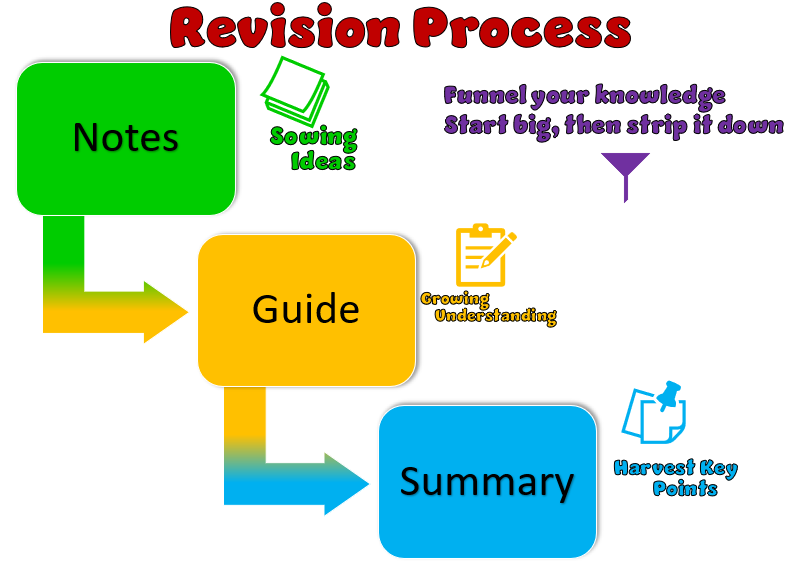
Revision – funnel your knowledge…
🧠 “Build your revision like a funnel — start wide with full notes, narrow it down to a clear guide, then finish with a short summary to keep the key points sharp for your practical.”
Revision process
🛠️ PREP STAGE – NOTES
Collect everything you need.
💡 BOOST STAGE – GUIDE
Streamline what matters.
🎯 LAUNCH STAGE – SUMMARY
Focus on the essentials for your practical.
In farming terms….
“Grow your knowledge, harvest your confidence!”
🌱 Notes – Sowing ideas
🌾 Guide – Growing understanding
🚜 Summary – Harvesting key points
In Summary
🚜 CORE REVISION
⚠️ Risk Assessments & Health & Safety (K1, S1)
- Identifying hazards vs risks (good for exam wording)
- Real farm examples (machinery, livestock, slurry pits)
- Links directly to safe working practices
🦠 Biosecurity (K2, S2)
- Clear explanation of disease spread routes
- Boot dips, isolation, visitor control
- Easy link to real farm routines apprentices see daily
🐄 Animal Welfare & Health (K3, K20, S3, S9)
- Covers signs of ill health (key exam topic)
- Behaviour, posture, appetite
- Can link to notifiable diseases like BSE
🐑 Handling & Moving Livestock (K4, S4)
- Shows correct movement and restraint
- Explains flight zones (very exam-relevant)
- Safer handling = better welfare
🚜 Tractors, ATVs & Machinery Safety (K5, S5)
- Pre-start checks
- PTO dangers (important!)
- Legal + safety awareness
🌱 Environmental & Sustainability (K6, S6, K16)
- Links to carbon, soil, biodiversity
- Easy intro to ICM (Integrated Crop Management)
- Good for “big picture” questions
🌾 Crop Quality & Monitoring (K7, K13, S15)
- Shows how crops develop
- Why monitoring matters (yield, quality)
- Links to pests, weeds, weather
🤖 Farm Technology (K8)
- Robotic milking systems
- GPS tractors
- Why maintenance matters
♻️ Waste & Environmental Protection (K9)
- Slurry, plastics, chemical disposal
- Legal responsibilities
- Links to pollution prevention
🌿 Grass & Forage Assessment (K10, S10)
- Sward height, covers, quality
- Practical field-based skills
- Very relevant for grazing systems
🥕 Livestock Feeding & Nutrition (K11, S11)
- Different diets by stage (youngstock, finishing, lactation)
- Water importance (often forgotten in exams)
❤️ Reproduction in Livestock (K12, S12)
- Covers oestrus signs (key exam weakness)
- AI vs natural service
- Pregnancy basics
🌍 Soil Sampling & Soil Types (K14, S13)
- Step-by-step sampling
- Why it matters for crops
- Links to fertiliser decisions
🚛 Transport & Loading (K15, S14)
- Securing loads
- Safe lifting
- Legal awareness
📝 Record Keeping (K17, S16)
- Why records matter (legal + business)
- Examples: medicine, movement, crops
🧱 Farm Maintenance & Fencing (K18, S8)
- Practical fence checks
- Safety risks if poorly maintained
- Good real-world visuals
🏷️ Product Quality & Customers (K19)
- Farm to fork idea
- Why specifications matter
- Links to supermarket requirements