
UK Viticulture at a Glance
🍇 The UK Vineyard Industry
| Measure | 2025 |
|---|---|
| Registered vineyards | 1,158 |
| Commercial vineyards | 779 |
| Active vine area | 4,358 ha |
| Young/non-productive vines | 533 ha |
| Wine produced | 124,378 hl |
| Approx. bottles | 16.6 million |
The key message:
UK viticulture is no longer a niche curiosity. It is a growing agricultural and food-production sector.
Where Are UK Vineyards?
🇬🇧 Major Vineyard Areas
| County | Approx. vine area |
|---|---|
| Kent | 1,239 ha |
| Sussex | 1,132 ha |
| Essex | 469 ha |
| Hampshire | 426 ha |
| Surrey | 130 ha |
Remember:
Vineyards are now found much further afield than the traditional south-east heartland.
Why Grapes?
☀️ Why Can Grapes Grow in Britain?
Successful vineyard sites can benefit from:
- Suitable soil
- Good drainage
- Favourable aspect
- Shelter
- Lower frost risk
- Suitable microclimate
- Sufficient sunlight
- Appropriate grape varieties
Think like a viticulturist
The question isn’t simply:
Can grapes grow here?
It is:
Can we grow grapes here consistently and profitably?
The Vineyard Business
From Field to Customer
LAND
↓
VINES
↓
GRAPES
↓
WINE
↓
MARKETING
↓
CUSTOMER
But it could also become:
Vineyard + Tours + Tastings + Shop + Events + Hospitality
Key point
A vineyard can be both a crop enterprise and a diversification enterprise.
What Does a Viticulturist Manage?
🌱 The Vine
Winter
- Pruning
- Trellis maintenance
- Soil management
Spring
- Bud development
- Frost management
- Shoot growth
- Disease monitoring
Summer
- Canopy management
- Crop-load management
- Nutrition
- Pest and disease control
Autumn
- Ripening
- Harvest
- Crop assessment
- Post-harvest management
The vineyard is managed all year — not just at harvest.
Why Is Viticulture Different?
🍇 Five Things to Remember
1. Permanent crop
Vines remain in the ground for many years.
2. High establishment cost
The investment comes well before full production.
3. Specialist management
Pruning and canopy management are fundamental.
4. Quality matters
Maximum yield isn’t necessarily the objective.
5. The business can go beyond the crop
Wine, tourism, hospitality and direct sales can all become part of the enterprise.
Key Varieties
🍾 Important English Wine Varieties
- Chardonnay
- Pinot Noir
- Pinot Meunier
These three varieties are particularly important in English sparkling wine production.
Remember
The choice of variety needs to match:
Site + Climate + Soil + Production System + Market
Agriculture or Horticulture?
The interesting question…
Is viticulture:
🌾 Agriculture?
🍎 Horticulture?
🍷 Food production?
🏨 Tourism?
💼 Business diversification?
Answer:
It can be all of them.
That is one reason viticulture is such an interesting area for agricultural professionals.
Apprentice Challenge
🤔 Would You Plant the Vineyard?
You have a 200-hectare arable farm.
You are considering planting 10 hectares of vines.
Before saying yes or no, investigate:
☐ Soil
☐ pH
☐ Drainage
☐ Aspect
☐ Frost risk
☐ Climate
☐ Variety
☐ Establishment costs
☐ Labour
☐ Machinery
☐ Market
☐ Expected yield
☐ Wine production
☐ Tourism potential
☐ Business risk
Your decision
Would you establish the vineyard?
Don’t just give an answer.
Use evidence to justify your decision.
Key Takeaway
🌱 It Starts With a Plant…
But viticulture is about much more than growing grapes.
Plant biology
Land
Climate
Crop management
Business
Market
=
🍇 A Vineyard Enterprise
The big question:
Can we build a viable agricultural business around growing grapes here?
What’s Next?
🔬 From the Vineyard to the Vine
Now that we understand why UK viticulture is growing, we need to understand the crop itself.
Our next question is:
What makes a vine work?
We’ll explore:
- Vine structure
- Roots
- Trunk and cordons
- Shoots
- Leaves
- Flowers
- Grapes
- Buds
- Growth cycles
- Photosynthesis
- Dormancy
Biology of the Vine
What is viticulture?
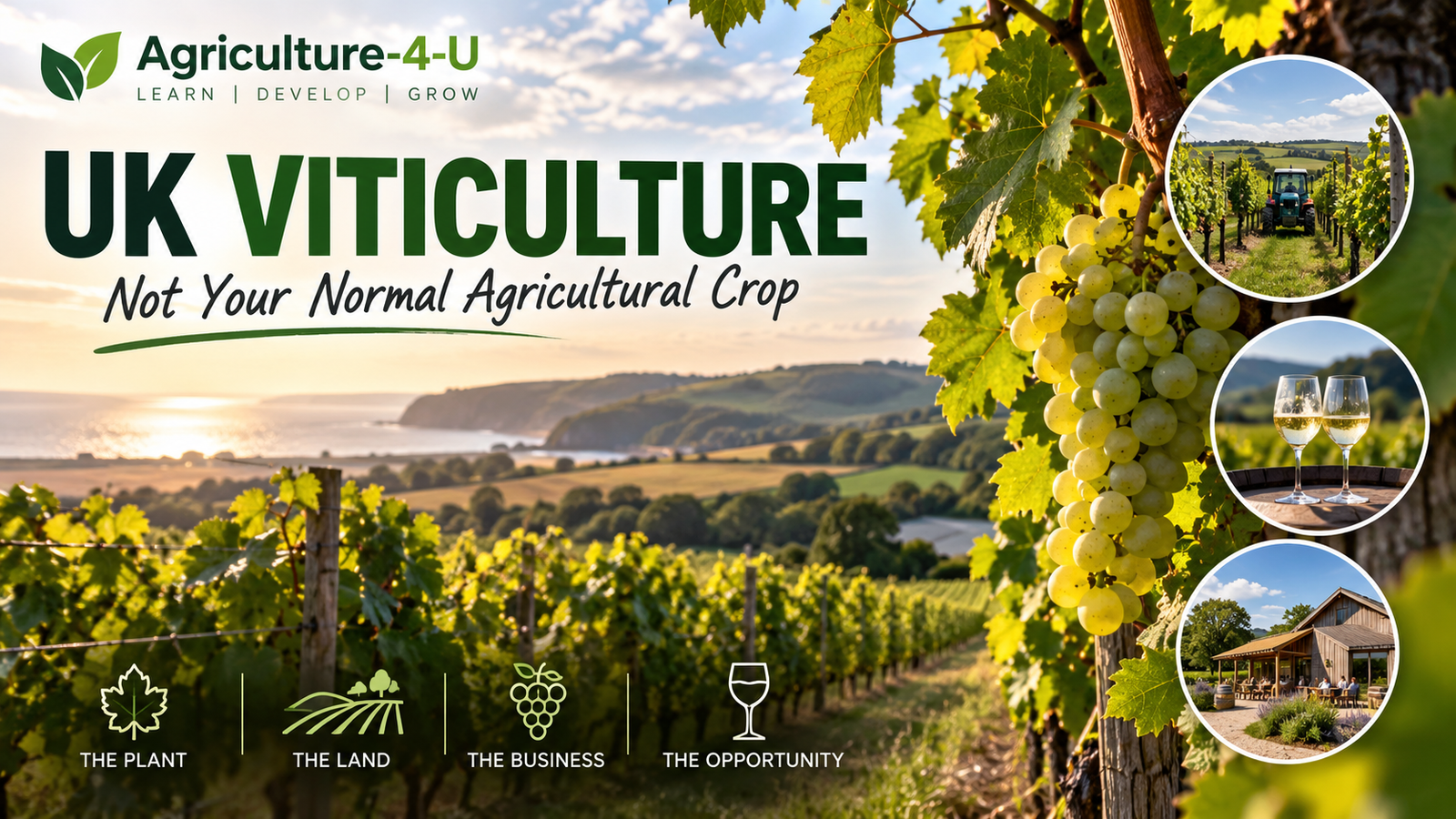
🔍 Click image to enlarge
Viticulture in the UK
Not Your Normal Agricultural Crop
When most people think about British agriculture, they probably picture fields of wheat, barley, oilseed rape, potatoes or grassland supporting livestock.
But there is another crop increasingly becoming part of the British agricultural landscape:
Grapes.
Viticulture is the cultivation and management of grapevines, particularly for wine production. Although vines are a relatively small part of UK agriculture, the sector has expanded rapidly in recent years and is creating new opportunities for farmers, landowners and the next generation of agricultural professionals.
And this is where viticulture becomes particularly interesting.
A vineyard is not simply another crop field.
It combines crop production, horticulture, long-term investment, specialist machinery, skilled manual work, marketing, tourism, food production and, in many cases, diversification of an existing farm business.
The UK Vineyard Industry Today
The UK wine industry has changed dramatically over the last two decades.
In 2025, the Food Standards Agency recorded:
| UK vineyard industry | 2025 figure |
|---|---|
| Registered vineyards | 1,158 |
| Commercial vineyards | 779 |
| Commercial wineries with vines | 190 |
| Commercial wineries without vines | 43 |
| Hobby vineyards | 90 |
| Abandoned vineyards | 56 |
| Active vines | 4,357.7 ha |
| Young/non-productive vines | 533.0 ha |
| 2025 wine production | 124,378 hl |
| Equivalent bottles | 16.58 million |
The number of registered vineyards increased by 4.3% between 2024 and 2025, while active vine area increased by almost 16%.
The 2025 harvest was particularly significant. UK production increased by approximately 55% compared with 2024, making it one of the largest harvests in the history of the British wine industry.
WineGB’s industry data gives the total area under vine in 2025 as approximately 4,841 hectares, showing just how quickly the planted area has expanded.
Where are the vineyards?
Vineyards can now be found across much of the UK, from Cornwall to Yorkshire and Wales to the Isle of Wight, although the industry remains strongly concentrated in southern England.
The largest producing counties include:
- Kent – 1,239 ha
- Sussex – 1,132 ha
- Essex – 469 ha
- Hampshire – 426 ha
- Surrey – 130 ha
England accounted for around 4,489 ha of vines in the 2025 Wine Standards data, with Wales contributing a further 91 ha.
Why Are Grapes Being Grown in Britain?
At first glance, growing grapes for wine in Britain seems rather unlikely.
Britain is not famous for hot, dry summers.
So why vineyards?
The answer is a combination of climate, soils, varieties, site selection, technology and investment.
The UK has experienced warmer growing conditions over recent decades, while modern grape varieties and vineyard management techniques have allowed growers to make better use of these conditions.
Southern England has some particularly suitable areas, with locations offering:
- suitable soils
- south-facing slopes
- good drainage
- protection from frost
- relatively warm microclimates
- sufficient sunlight
- access to markets and infrastructure
The famous sparkling-wine varieties Chardonnay, Pinot Noir and Pinot Meunier have become particularly important to the English wine industry.
But the UK vineyard is still a relatively young agricultural sector. Regional identities and production systems are continuing to develop.
Viticulture as Farm Diversification
One of the most interesting aspects of the UK vineyard boom is that many vineyards have not been created from completely new agricultural businesses.
Some have been established by existing farmers looking for a new enterprise.
This makes viticulture an excellent example of agricultural diversification.
Diversification means developing additional business activities alongside the farm’s traditional enterprises.
For example, an arable farm might traditionally produce:
Wheat → Barley → Oilseed Rape → Beans
A diversified farm might add:
Vineyard → Grapes → Wine → Tours → Tastings → Events
The vineyard therefore becomes much more than simply another crop.
It can potentially create several income streams from the same piece of land.
From Field to Customer
A conventional combinable crop might follow a relatively familiar chain:
Soil → Crop → Harvest → Grain Store → Merchant → Market
Viticulture can look very different:
Soil → Vines → Grapes → Harvest → Winery → Wine → Brand → Customer
And the business may continue beyond wine production:
Vineyard → Tours → Tastings → Shop → Events → Hospitality
This creates an important difference for the farmer.
The business is not necessarily just about producing a crop efficiently.
It can also be about creating a product and selling an experience.
Real Farms Taking the Vineyard Route
There are already examples of established farming businesses using viticulture as a diversification enterprise.
Rutland Vineyard – Lincolnshire
The Beaver family operate a 550-hectare arable farm growing crops including wheat, sugar beet and spring barley.
They established a vineyard on approximately 7 acres, planting thousands of vines.
The project was intended to provide an additional income stream while creating a new connection between the farm and the public.
The business has subsequently developed a tasting barn, tours and a nature trail.
This is a useful example because the vineyard sits alongside, rather than simply replacing, an established arable farming business.
Lockley Farm – Hertfordshire
Lockley Farm is a second-generation arable farm traditionally producing crops including:
- wheat
- barley
- oats
- beans
The family established a 15-acre vineyard in 2022 after assessing factors including soil, aspect and frost risk.
The project also provided an opportunity for the next generation of the family to develop a new enterprise within the existing farming business.
This illustrates an important point about diversification:
Diversification is not always about abandoning traditional farming. It can be about adding a new enterprise to the existing business.
West Ilsley – Berkshire
Another example is the Carlisle family’s farm at West Ilsley in Berkshire.
The family investigated the potential for viticulture as a diversification project and monitored weather conditions across the farm for several years before selecting a suitable site.
Their vineyard covers approximately 6.5 hectares.
The family’s experience demonstrates how much more detailed site selection can become when establishing a permanent crop such as vines.
Why Is a Vineyard Different?
A vineyard changes the way we think about crop production.
1. It is a long-term crop
A cereal crop is planted and harvested within a single growing season.
A vineyard is very different.
Vines are a permanent crop and can remain productive for many years.
Establishing the vineyard therefore represents a major long-term commitment of land and capital.
HMRC guidance notes that vines can take approximately five years to reach full productivity.
The farmer therefore has to think beyond:
“What will I grow this year?”
and instead ask:
“What will this field be producing for the next 20–30 years?”
2. Site selection becomes critical
A cereal crop can be changed relatively easily from one year to the next.
A vineyard cannot.
Before planting, the grower needs to consider:
Soil → Aspect → Drainage → Frost → Climate → Water → Access → Machinery → Labour → Markets
A poor decision at establishment can affect the vineyard for decades.
3. The crop is highly managed
Vines require a very different approach to crop management.
Instead of simply establishing a crop and monitoring it through the season, the viticulturist manages the vine canopy and fruiting structure throughout the year.
This includes activities such as:
- pruning
- tying
- shoot positioning
- canopy management
- leaf removal
- crop-load management
- disease monitoring
- nutrition
- weed control
- pest management
- irrigation where appropriate
- harvesting
The crop is being managed not simply to maximise yield, but to achieve the right balance between vine growth, crop load, fruit ripeness and wine quality.
It Is Still Agriculture
Despite all of the differences, it is important not to lose sight of one thing:
Viticulture is agriculture.
The vineyard still depends upon:
🌱 Soil
☀️ Climate
💧 Water
🌿 Plant biology
🦠 Pest and disease management
🚜 Machinery
👩🌾 Skilled labour
📊 Business management
🌍 Environmental management
The difference is that viticulture brings all of these together within a high-value, permanent crop system.
A New Type of Agricultural Business
UK vineyards also demonstrate how agriculture is changing.
A modern vineyard may involve people working in:
Viticulture
↓
Winemaking
↓
Food production
↓
Marketing
↓
Retail
↓
Tourism
↓
Hospitality
↓
Events
This means that the agricultural professional working in viticulture may need a broader range of skills than simply growing the crop.
They need to understand the plant, the land, the business and increasingly the customer.
Why Does This Matter to Agriculture Apprentices?
For an agricultural apprentice, viticulture provides a fascinating example of how agricultural businesses can develop.
It demonstrates that a farmer does not necessarily have to choose between:
Traditional farming OR diversification
Instead, the future may involve:
Traditional farming + new crops + new markets + new enterprises
The UK vineyard sector provides a real-world example of this process happening now.
It also shows why agricultural professionals need to understand more than individual production techniques.
A successful enterprise requires the ability to:
- assess land
- understand soils
- interpret climate
- manage crops
- operate machinery
- manage labour
- monitor performance
- control costs
- understand markets
- manage risk
- meet regulations
- communicate with customers
- adapt to changing conditions
The Big Question
The growth of UK viticulture raises an interesting question for farmers:
Could grapes become another agricultural crop — or are vineyards becoming something much bigger than a crop?
The answer depends on how the business is structured.
For some businesses, the vineyard may simply be a crop enterprise selling grapes to a winery.
For others, it may become a complete vine-to-bottle business.
For others still, the vineyard may form the centre of a wider diversification enterprise involving:
Wine + Tourism + Hospitality + Retail + Events + Education
That is what makes viticulture such an interesting area of modern agriculture.
It starts with a plant — but the business can grow far beyond the field.
Viticulture: The Challenge
Imagine you are running a 200-hectare arable farm.
You have:
- good agricultural land
- established machinery
- existing buildings
- an experienced workforce
- a reliable arable rotation
But you want to develop another income stream.
You are considering planting 10 hectares of vines.
Before planting a single vine, what would you need to investigate?
Think about:
LAND
- Soil type
- Soil structure
- pH
- Drainage
- Aspect
- Slope
- Frost risk
CROP
- Variety
- Rootstock
- Planting density
- Trellis system
- Yield
- Canopy management
RESOURCES
- Labour
- Machinery
- Water
- Buildings
- Storage
BUSINESS
- Establishment costs
- Annual costs
- Time before production
- Expected yield
- Grape price
- Wine price
- Market
CUSTOMERS
- Who will buy the grapes?
- Who will buy the wine?
- Could the farm sell directly?
- Could tourism become part of the business?
RISK
- Frost
- Weather
- Disease
- Birds
- Pests
- Labour availability
- Market conditions
- Establishment costs
The decision to plant a vineyard is therefore not simply:
“Can we grow grapes here?”
It is:
“Can we build a viable agricultural business around growing grapes here?”
And that is where viticulture becomes agriculture — but not agriculture as usual.
Below is presentation which gives more details about Oilseeds grown in the UK.