
What is a Vine?
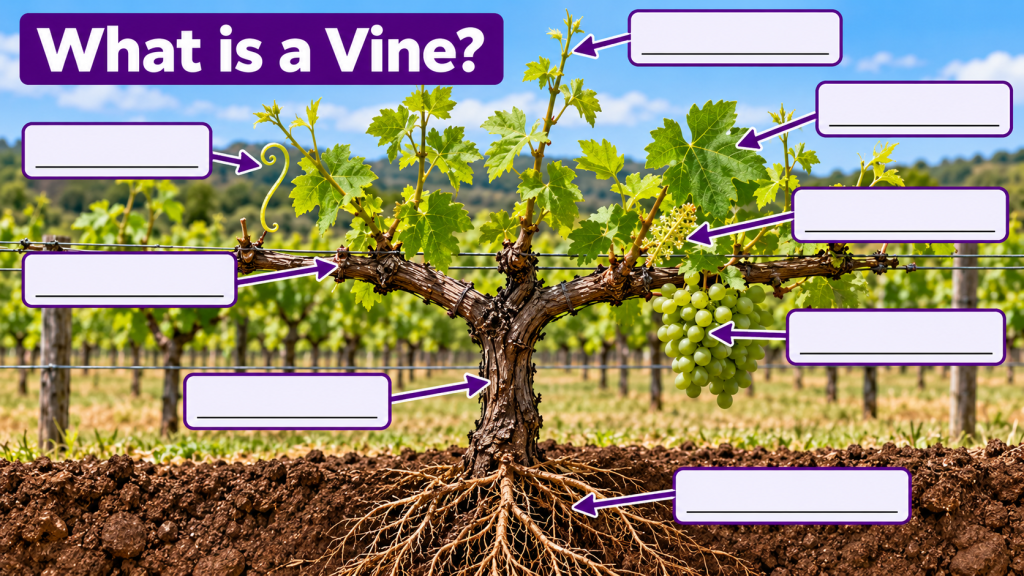
🧠 Build Your Technician Knowledge
- Identify and explain the main structural parts of a grapevine
- Explain the difference between permanent structure and annual growth
- Explain why vine structure matters when making vineyard management decisions.
🎯 The Big Picture
Your goal is to understand that a grapevine is a long-lived, woody perennial plant with a permanent framework and a cycle of new annual growth.
The important sequence is:
🌳 Structure
Roots → Trunk → Cordon/Cane
🌱 Growth
Bud → Shoot → Leaves
🌼 Reproduction
Flower → Fruit set → Bunch
🍇 Ripening
Berry development → Veraison → Ripening → Harvest
And underneath all of this is the continuous interaction between:
Soil ↔ Roots ↔ Vine ↔ Canopy ↔ Crop ↔ Environment
That biological understanding becomes the foundation for everything that follows in Viticulture.
🔗 Why Vine Biology Matters to a Crop Technician
Understanding the vine allows you to understand why vineyard operations are carried out.
| Vineyard operation | Biological reason |
|---|---|
| Planting | Establish a healthy root system and vine framework |
| Training | Position permanent wood and annual growth |
| Pruning | Control buds, shoots and potential crop |
| Shoot positioning | Manage canopy structure |
| Leaf removal | Alter light and airflow around fruit |
| Crop thinning | Adjust crop load |
| Nutrition | Supply nutrients required for growth and production |
| Irrigation | Manage water availability |
| Crop protection | Protect leaves, shoots and fruit |
| Harvesting | Remove fruit at the required stage of development |
🔍 Look – Think – Learn – Explore – Workplace – Decide
👀 LOOK
Examine a real vine or a photograph.
Identify:
- Roots
- Trunk
- Permanent wood
- Cordon
- Cane
- Buds
- Shoots
- Leaves
- Inflorescences
- Bunches
🤔 THINK
Consider this question:
Where does next year’s growth come from?
What happens to a shoot at the end of the growing season?
What happens to it during winter?
📖 LEARN
Make sure you can explain the function of:
Roots → Trunk → Cordon → Cane → Bud → Shoot → Leaf → Flower → Berry
Don’t just learn the names — learn what each part does.
🌐 EXPLORE
Compare two different training systems.
For example:
Cane-pruned vine
versus
Cordon-trained vine
Ask:
What has the grower changed about the natural structure of the vine?
🚜 WORKPLACE
On a real vineyard, identify at least five vine structures.
Then choose two and explain:
- What they are.
- What they do.
- Why they matter to vineyard management.
🧠 DECIDE
Imagine you are pruning a mature vine.
You need to decide:
- Which wood remains?
- Which wood is removed?
- How many buds are retained?
- Where will next year’s shoots develop?
- How will this affect the canopy?
- How might it affect crop potential?
The key question:
How does a pruning decision made in winter influence the vine several months later?
Biology of the vine.
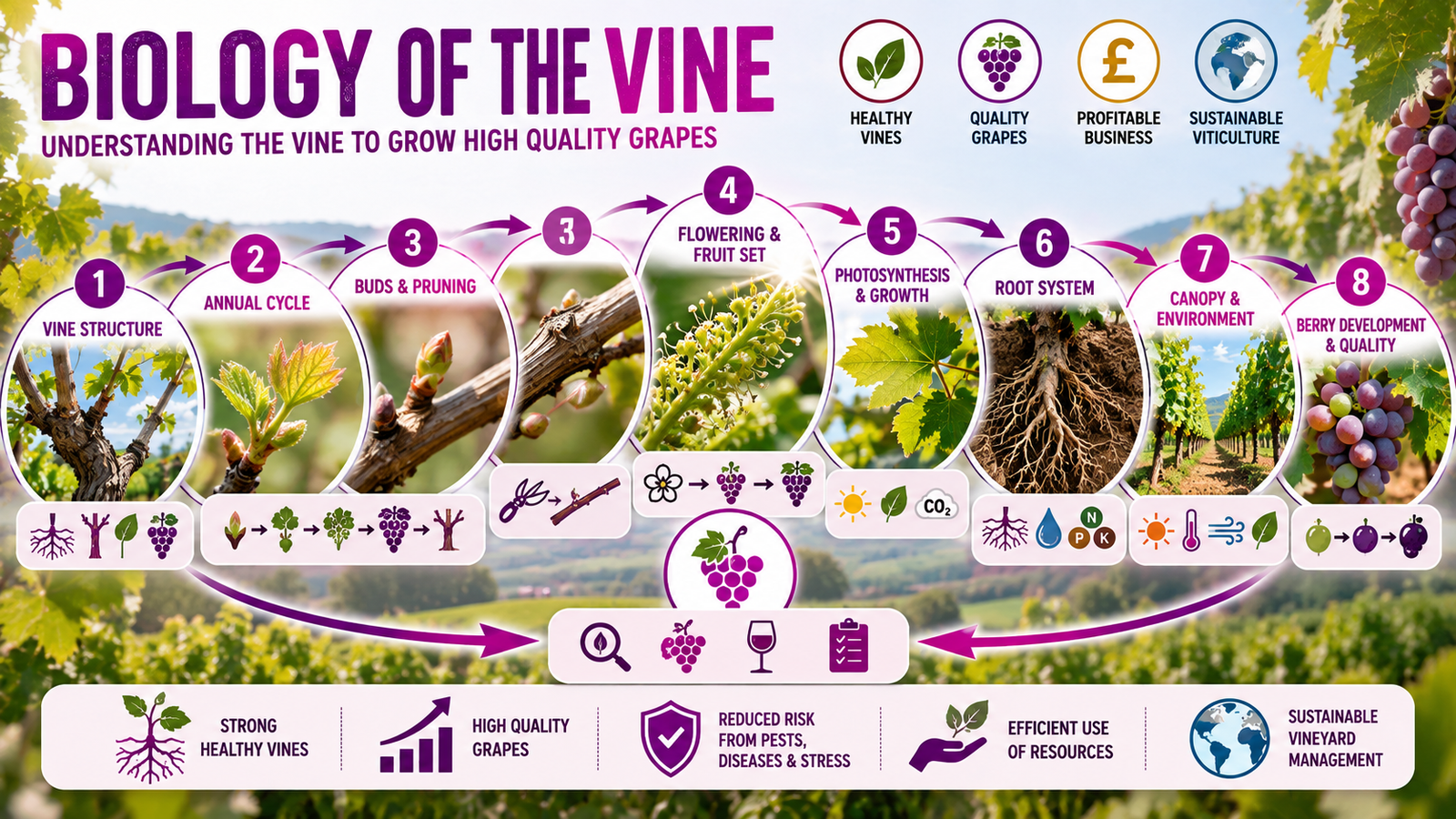
🔍 Click image to enlarge
🍇 What Is a Vine?
A grapevine is a perennial woody plant grown to produce grapes. Unlike an annual crop such as wheat, a vine can remain productive for many years. Each year, the vine produces new shoots, leaves, flowers and grapes from a permanent framework of older wood.
Understanding the structure and biology of the vine is essential because almost every vineyard operation — pruning, training, canopy management, nutrition, crop protection and harvesting — is based on how the vine grows.
The key idea: A vineyard manager is not simply managing grapes. They are managing a living plant and its balance between vegetative growth, reproduction and stored resources.
🌱 The Grapevine at a Glance
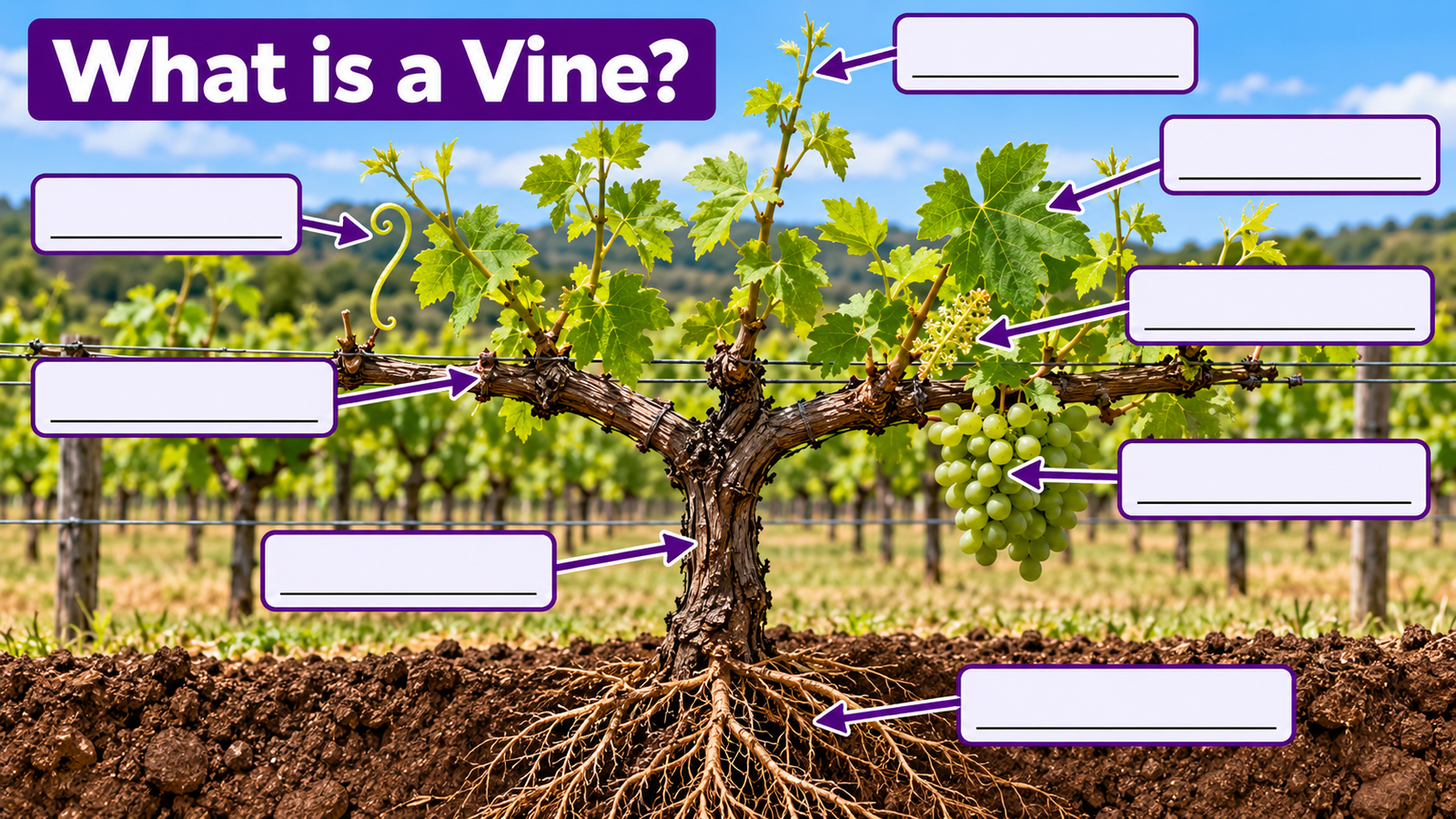
🔍 Click image to see answers
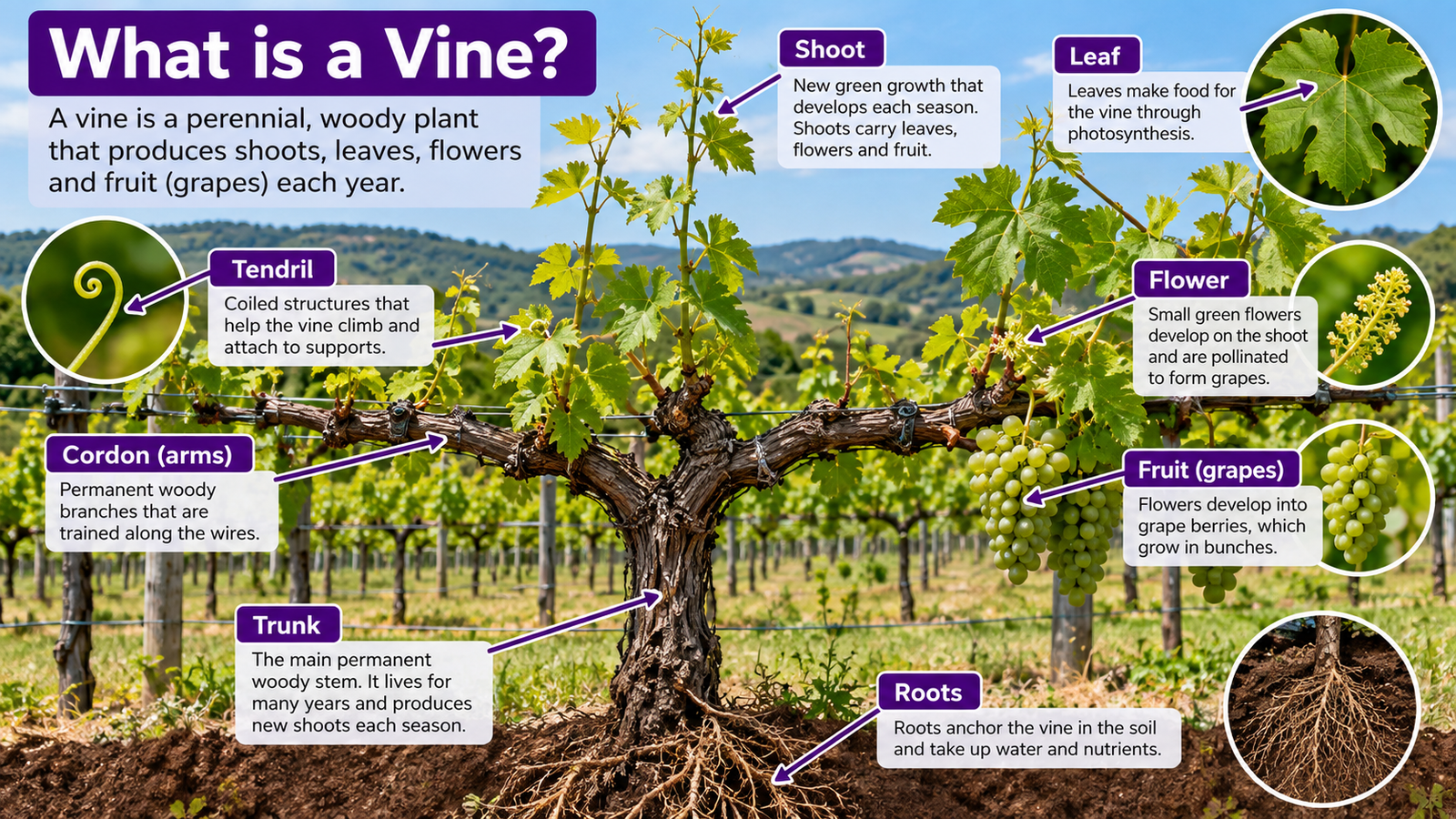
A cultivated grapevine can be thought of as having two main systems:
🌳 Permanent structure
These parts remain from year to year:
- Roots
- Trunk
- Cordons, where present
- Older permanent wood
🌿 Annual growth
These parts are produced during the growing season:
- Buds
- Shoots
- Leaves
- Inflorescences / flowers
- Bunches
- Berries
- New canes
The distinction between permanent wood and annual growth is fundamental to understanding pruning and training.
🌳 1. Roots
The root system anchors the vine and supplies it with water and mineral nutrients.
Roots also act as an important storage organ, particularly for carbohydrates and other reserves that the vine uses when growth begins in spring.
Main functions
| Function | What it means |
|---|---|
| Anchorage | Holds the vine securely in the soil |
| Water uptake | Supplies water needed for growth and transpiration |
| Nutrient uptake | Absorbs mineral nutrients from the soil |
| Storage | Stores carbohydrates and other reserves |
| Exploration | Allows the vine to exploit soil at different depths |
Root growth is influenced by soil structure, moisture, temperature, fertility, drainage and soil biology.
Why does this matter?
A vine with a healthy, functioning root system is better able to support shoot growth and fruit production.
This is why vineyard decisions about soil management, drainage, irrigation, nutrition and establishment can have long-term effects on vine performance.
🌳 2. Trunk
The trunk is the main permanent stem of the vine.
It supports the canopy and provides the main pathway for movement of water, minerals and carbohydrates between the roots and above-ground parts of the plant.
The trunk may be relatively short or taller depending on the training system and vineyard objectives.
The trunk can also store reserves
Perennial parts of the vine, including the trunk and roots, can store carbohydrates that help support early-season growth.
Why does this matter?
Damage to the trunk can have long-term consequences because, unlike an annual crop, the vine may remain in production for many years.
🌿 3. Cordons
A cordon is a permanent horizontal or semi-horizontal arm extending from the trunk.
Cordons are used in many training systems and carry the positions from which new shoots develop.
The permanent cordon is sometimes called old wood or permanent wood.
Cordon-trained vines
On a cordon-trained vine:
Trunk → Cordon → Spurs/Buds → Shoots → Leaves & Grapes
This creates a permanent framework that is maintained through pruning.
🌿 4. Canes
A cane is a shoot from a previous season that has matured and become woody.
Canes are particularly important in cane-pruned training systems.
During pruning, selected canes may be retained to provide the buds from which the next season’s shoots will develop.
Cane vs cordon
| Cane | Cordon |
|---|---|
| Usually retained for a limited period | Permanent part of the framework |
| Usually replaced during pruning | Maintained over several years |
| Carries buds for future shoots | Carries spurs/buds or fruiting positions |
| Important in cane pruning | Important in spur/cordon systems |
Important: A cane is not simply “any bit of wood”. It specifically refers to matured one-year-old wood in the context of vine structure and pruning.
🌱 5. Buds
Buds are extremely important because they contain the developing structures that will produce the following season’s growth.
A bud can potentially produce:
Shoot → Leaves → Inflorescences → Grapes
The number and position of retained buds therefore have a major influence on potential crop and canopy development.
Buds and pruning
When pruning a vine, the grower is effectively deciding:
How much potential growth and crop am I going to retain for next season?
This is one reason why pruning is much more than simply cutting wood off a vine.
🌿 6. Shoots
A shoot is the actively growing green stem produced from a bud.
Shoots carry:
- Leaves
- Tendrils
- Inflorescences
- Developing bunches
- Growing points
As the season progresses, the shoot eventually matures and becomes woody.
At this stage it becomes a cane.
The annual cycle
Bud → Shoot → Mature shoot/cane → Pruning
This cycle is central to vine management.
🍃 7. Leaves
Leaves are the main photosynthetic organs of the vine.
Through photosynthesis, the vine uses:
Light + Carbon dioxide + Water → Sugars + Oxygen
The sugars produced are used for:
- Shoot growth
- Root growth
- Fruit development
- Respiration
- Storage reserves
The leaves therefore provide much of the energy that allows the vine to grow and ripen its crop.
☀️ Why the canopy matters
More leaves do not automatically mean a better vine.
The grower needs an effective balance between:
Leaf area → Light interception → Photosynthesis → Crop development
while avoiding an excessively dense canopy.
A dense canopy can reduce:
- Light penetration
- Air movement
- Spray penetration
- Drying of leaves and fruit
This links vine biology directly to later teaching on canopy management and crop protection.
🌼 8. Flowers and Inflorescences
The vine produces its flowers in structures called inflorescences.
These develop on shoots and eventually become grape bunches following successful flowering and fruit set.
For many cultivated grape varieties, the flowers are self-fertile, meaning pollination does not normally require insects to transfer pollen between vines.
The sequence
Inflorescence → Flowering → Pollination/Fertilisation → Fruit set → Bunch development
Conditions during flowering can influence the number of berries that successfully develop.
This is one reason why weather during the flowering period can have important consequences for crop yield.
🍇 9. Bunches
After successful fruit set, the developing inflorescence becomes a grape bunch.
A bunch consists of:
- Berries
- Rachis – the central stem and branches supporting the berries
- Pedicels connecting individual berries to the rachis
The bunch develops throughout the growing season.
Eventually the berries reach the stage at which they are harvested for their intended purpose.
🍇 10. Berries
The grape berry is the part that ultimately provides the raw material for wine production.
A berry contains several important components:
Skin
Contains compounds including:
- Pigments
- Tannins
- Aromatic compounds
- Other phenolic compounds
Pulp
Contains much of the:
- Water
- Sugars
- Organic acids
Seeds
Contain oils and phenolic compounds.
Why does this matter?
The composition of the berry changes as it develops and ripens.
The grower is therefore trying to manage the vine so that the crop reaches the desired balance of:
Sugar + Acidity + pH + Flavour + Phenolic development + Yield
This becomes particularly important when we study berry development, veraison and harvest quality.
🔄 How the Parts Work Together
The vine is not a collection of separate components. It is an integrated system.
Think of the vine as a supply-and-demand system:
ROOTS
↓
Water + nutrients + stored reserves
↓
TRUNK & CORDONS
↓
Transport and structural support
↓
SHOOTS & LEAVES
↓
Photosynthesis and canopy development
↓
FLOWERS
↓
Fruit set
↓
BERRIES
↓
Ripening and crop production
At the same time, carbohydrates produced by the leaves can be transported to other parts of the plant and stored for future use.
🌳 Permanent Wood vs Annual Growth
This is one of the most important concepts to understand.
| Permanent / older structure | Annual growth |
|---|---|
| Roots | New shoots |
| Trunk | Leaves |
| Cordons | Flowers |
| Older wood | Bunches |
| Framework | New canes |
Why does this matter?
Because vineyard management involves managing both.
For example:
Pruning controls the amount and position of annual growth.
Training determines how the permanent framework and annual shoots are arranged.
Canopy management controls the distribution of leaves and shoots.
Crop management influences the relationship between fruit production and vegetative growth.
⚖️ The Vine: Growth vs Crop
A grapevine has to balance two major activities:
🌿 Vegetative growth
Producing:
- Shoots
- Leaves
- Roots
- Wood
🍇 Reproductive growth
Producing:
- Flowers
- Fruit
- Seeds
The aim of vineyard management is not simply to maximise growth or maximise yield.
Instead, the grower is trying to create an appropriate balance between vegetative growth and reproductive development for the vineyard, variety, site and production objective.
Too little growth: insufficient leaf area and poor crop development.
Too much growth: excessive canopy, shading and management problems.
This concept of vine balance will appear repeatedly throughout the Viticulture course.
🔗 Why Vine Biology Matters to a Crop Technician
Understanding the vine allows you to understand why vineyard operations are carried out.
| Vineyard operation | Biological reason |
|---|---|
| Planting | Establish a healthy root system and vine framework |
| Training | Position permanent wood and annual growth |
| Pruning | Control buds, shoots and potential crop |
| Shoot positioning | Manage canopy structure |
| Leaf removal | Alter light and airflow around fruit |
| Crop thinning | Adjust crop load |
| Nutrition | Supply nutrients required for growth and production |
| Irrigation | Manage water availability |
| Crop protection | Protect leaves, shoots and fruit |
| Harvesting | Remove fruit at the required stage of development |
So when you are asked to carry out a vineyard task, don’t just ask:
“How do I do this?”
Also ask:
“What is happening biologically, and what am I trying to achieve?”
That is the difference between carrying out a vineyard operation and beginning to think like a Crop Technician.
🧩 Put the Vine Together
Try to arrange these in the correct order:
Roots → Trunk → Cordon/Cane → Bud → Shoot → Leaf → Flower → Berry
But remember: they do not operate as a simple linear chain.
The vine is a connected system in which water, minerals, sugars and stored reserves move between different parts of the plant.
⭐ Stretch Challenge
Create your own “How a Vine Works” diagram.
Your diagram should show:
Roots → Trunk → Permanent framework → Buds → Shoots → Leaves → Flowers → Bunches → Berries
Add arrows showing the movement of:
💧 Water
🧪 Mineral nutrients
☀️ Energy from photosynthesis
🍬 Sugars / carbohydrates
Then add a short explanation:
How does the whole vine work together to produce a crop of grapes?
📝 Quick Knowledge Check
Can you answer these without looking back?
1. What makes a grapevine different from an annual crop?
2. What is the main function of the roots?
3. What is a cordon?
4. What is the difference between a cane and a cordon?
5. What develops from a bud?
6. What is the main function of the leaves?
7. What is an inflorescence?
8. What happens after successful fruit set?
9. Why is the distinction between permanent wood and annual growth important?
10. Why does a Crop Technician need to understand vine biology?
🎯 The Big Picture
You should now understand that a grapevine is a long-lived, woody perennial plant with a permanent framework and a cycle of new annual growth.
The important sequence is:
🌳 Structure
Roots → Trunk → Cordon/Cane
🌱 Growth
Bud → Shoot → Leaves
🌼 Reproduction
Flower → Fruit set → Bunch
🍇 Ripening
Berry development → Veraison → Ripening → Harvest
And underneath all of this is the continuous interaction between:
Soil ↔ Roots ↔ Vine ↔ Canopy ↔ Crop ↔ Environment
That biological understanding becomes the foundation for everything that follows in Viticulture..
Below is presentation which gives more details about Oilseeds grown in the UK.