
Caring for Vines
🧠 Build Your Technician Knowledge
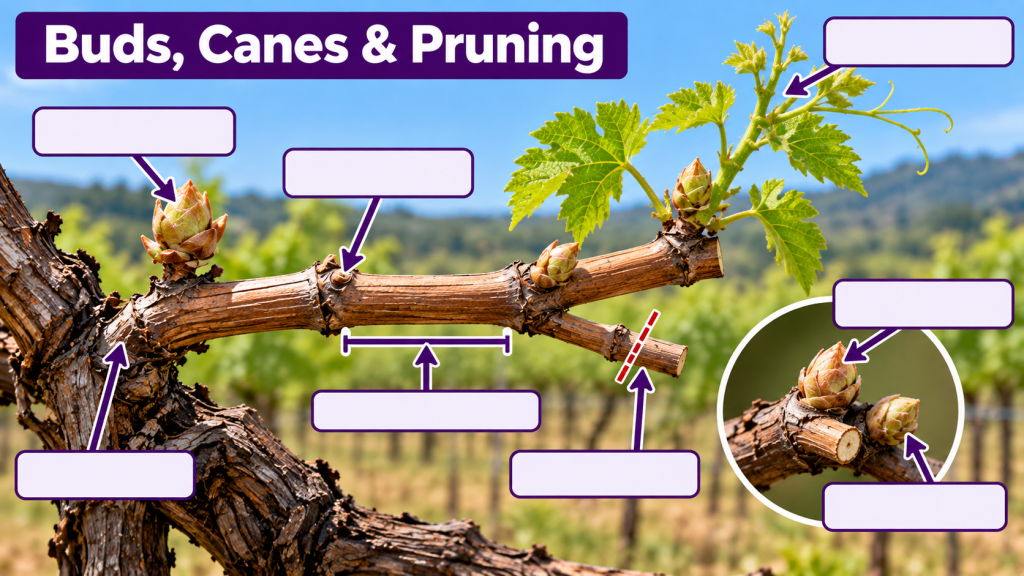
- Identify buds, nodes, internodes, canes and spurs.
- Explain how buds develop into shoots and why one year old wood matters.
- Use bud and cane knowledge to explain a simple pruning decision and these choices could influence growth and crop potential

⚖️ Long Cane vs Short Spur
| Feature | Long Cane | Short Spur |
|---|---|---|
| Wood retained | Longer cane | Short spur |
| Buds retained | Usually more per retained cane | Fewer per spur |
| Growing points | Distributed along cane | Concentrated at spur positions |
| Example | Guyot | Cordon spur pruning |
| Canopy arrangement | Depends on training system | Depends on cordon layout |
| Pruning decision | Which cane and buds to retain | Which spurs and buds to retain |
The important point is that pruning and training work together.
The same number of buds can produce very different vine structures depending on where those buds are positioned.
🍇 Interesting facts about pruning grapevines
- ✂️ Pruning can remove 80–90% of the previous season’s growth. It looks brutal, but this is deliberate: the aim is to control where the vine grows next year rather than simply allowing it to keep expanding.
- 🌱 A bud is more than just a future leaf. A dormant grapevine bud contains miniature structures that can develop into a shoot, leaves, tendrils and potentially flower clusters.
- 🍇 Next year’s crop is partly decided during this year’s growth. The buds that will produce next year’s shoots and clusters develop within the current season’s shoots before those shoots become dormant wood.
- ❄️ Pruning time matters. In many UK vineyards, pruning is carried out during winter, but delaying pruning can be useful where spring frost is a significant risk because later budburst may help avoid the earliest frosts.
- 🔥 Pruning creates a surprisingly large amount of waste wood. Vineyards have to deal with tonnes of prunings. They may be chipped, mulched, burned where permitted, or removed from the vineyard.
- 🌳 A grapevine can become very old. With suitable management, vines can remain productive for decades. Some vineyards have vines well over 100 years old. Their trunks can become dramatically thick and twisted.
- 🧬 Not every bud is equal. Bud fertility varies according to grape variety, position along the cane and the conditions experienced during the previous growing season.
- 🍇 More buds don’t necessarily mean more grapes. Leaving more buds can increase potential crop, but if the vine produces excessive shoots, competition for light and resources can result in a dense canopy and poorer fruit development.
- ⚖️ Pruning is really about balance. The grower is trying to balance the vine’s vegetative growth with its reproductive growth — essentially leaves and shoots versus fruit.
- 🌿 A cane and a spur are not the same thing. A cane is usually a longer section of one-year-old wood carrying several buds. A spur is a short section of older wood retained with a small number of buds.
- 🍷 The pruning system can influence the wine. Pruning affects shoot number, canopy structure, fruit exposure and ultimately the environment in which grapes ripen. It doesn’t determine wine quality on its own, but it is part of the chain of decisions leading to the finished wine.
- 👨🌾 Pruning is one of the most skilled jobs in a vineyard. Two people can look at the same vine and make different pruning decisions based on vine vigour, previous growth, variety, training system, crop target and vineyard conditions.
🤯 One particularly good fact
A vine doesn’t know that you’re trying to grow grapes.
It is fundamentally trying to grow, survive and reproduce.
Pruning is the grower’s way of redirecting that natural growth habit towards a manageable canopy and a useful crop.
Vine biology → Buds → Pruning → Shoot growth → Canopy → Fruit → Harvest
✂️ Pruning isn’t about cutting off last year’s growth — it’s about deciding where next year’s growth will happen.
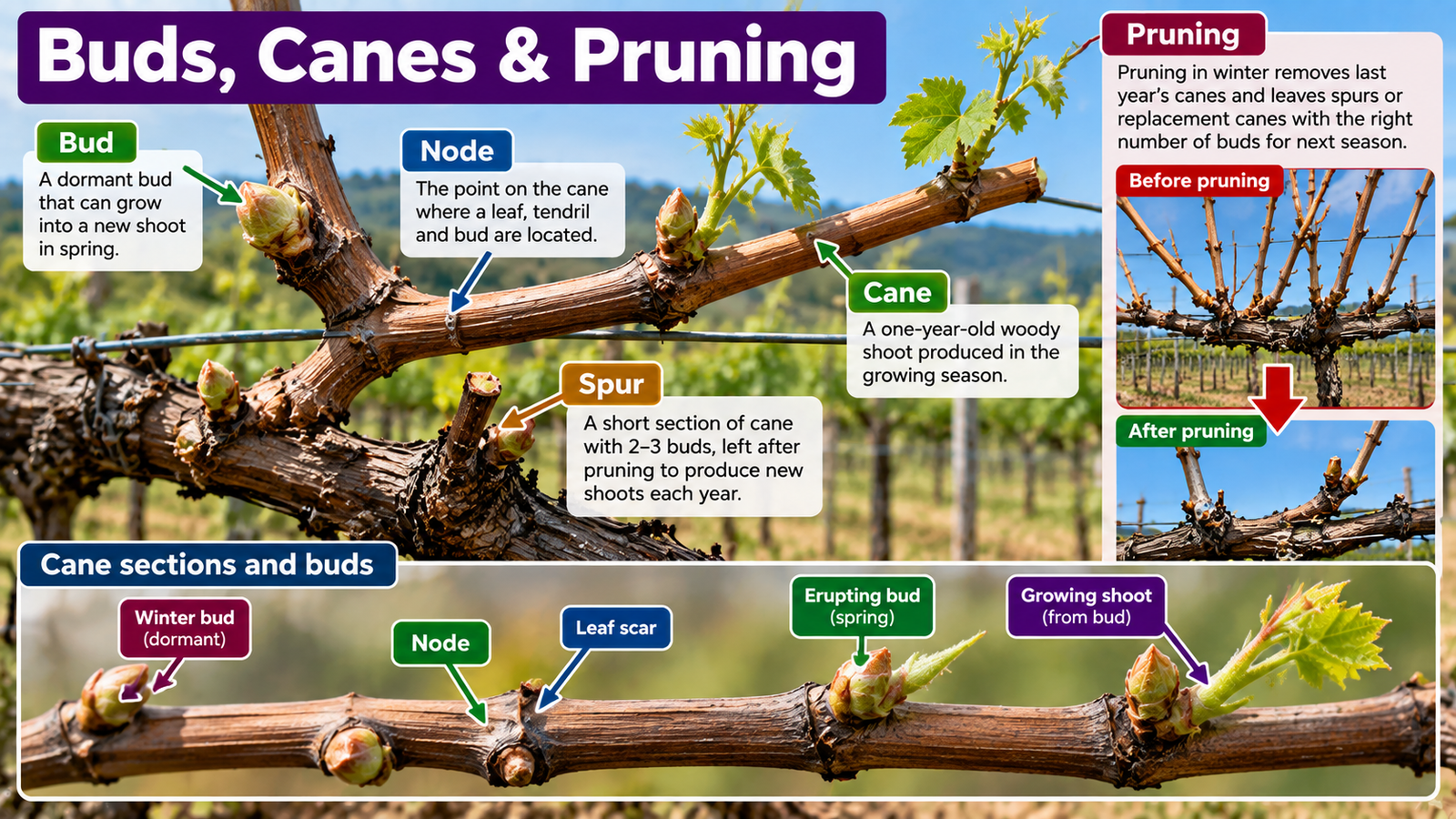
✂️ Buds, Canes & Pruning
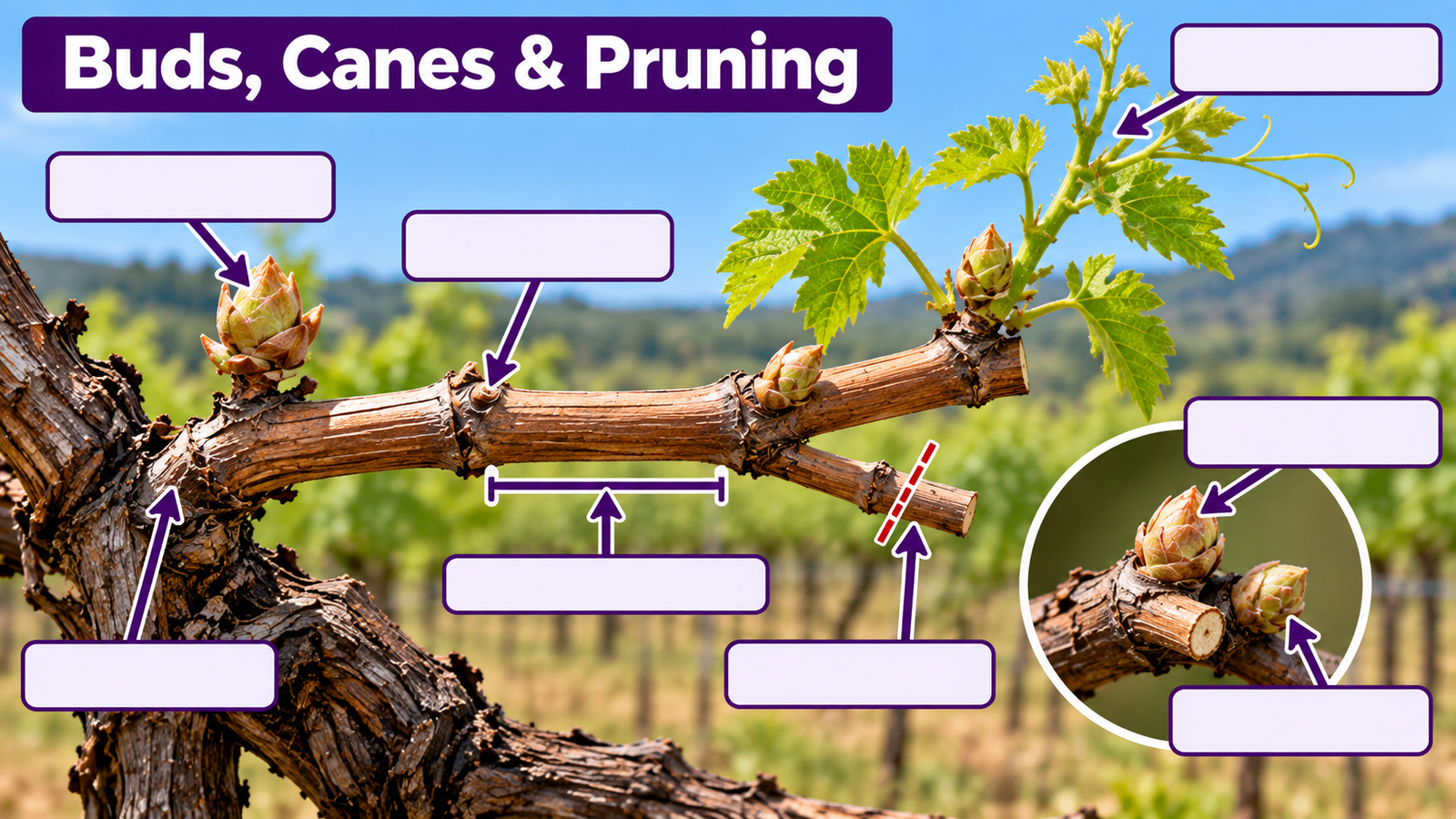
🔍 Click image to see answers
🌿 Why does pruning matter?
A dormant grapevine can look deceptively simple. Once the leaves have fallen, however, the vine contains the framework for next season’s growth.
The grower is not simply cutting wood away. Pruning is a decision about where the next season’s shoots and fruit will come from.
Understanding the biology behind buds, nodes and one-year-old wood helps explain why different pruning systems are used and why the position and number of buds retained can have a major influence on vine growth and crop potential.
Pruning is really planning next year’s vine before it starts growing.
🌱 Start with the Dormant Vine
During winter, the vine enters a period of dormancy. Leaves have fallen and shoot growth has stopped, but the vine still contains living buds and stored reserves.
Look closely at a dormant vine and you can identify:
- Trunk – the permanent main stem of the vine
- Cordons – permanent arms extending from the trunk
- Canes – usually one-year-old shoots that have matured and become woody
- Buds – structures that can develop into new shoots
- Nodes – points along the cane where buds and leaves developed
- Internodes – sections of cane between nodes
- Spurs – short sections of older cane retained after pruning
👀 Look
Look at a dormant vine.
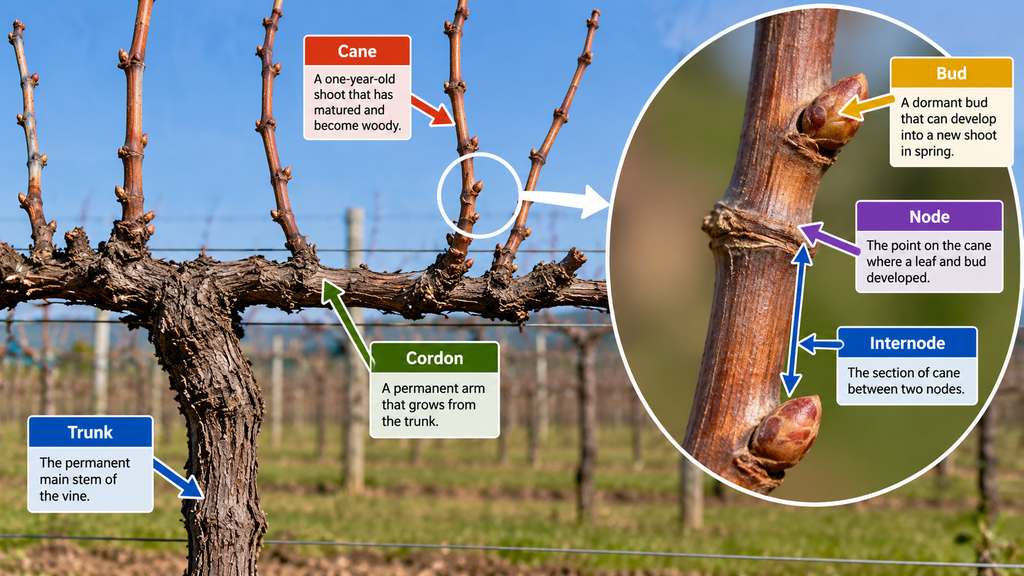
Can you identify:
Trunk → Cordon → Cane → Node → Bud
Then ask:
Where will next season’s shoots come from?
🌰 Buds – The Starting Point of New Growth
A grapevine bud is much more than a small swelling on a cane.
It contains developing structures that can produce a new shoot during the following growing season.
When conditions become suitable in spring, buds begin to grow and produce shoots containing:
- leaves
- tendrils
- flower clusters
- growing points
This makes the position and number of buds retained during pruning extremely important.
More retained buds can potentially produce more shoots and more fruiting sites.
However, more buds does not automatically mean more useful production.
The vine still needs to support the resulting growth with sufficient:
- light
- water
- nutrients
- photosynthetic capacity
- space within the canopy
💡 Think
If a vine is pruned leaving many buds, what might happen when spring arrives?
Consider both the potential advantages and the possible problems.
🍇 One-Year-Old Wood
One-year-old wood is particularly important in many vineyard systems because it carries the buds that will produce the next season’s shoots.
During the previous growing season, a green shoot develops and matures.
By autumn and winter it becomes woody and enters dormancy.
This mature cane can then provide the buds from which the following year’s shoots develop.
A simple sequence
Green shoot → Mature cane → Dormant cane → Bud burst → New shoot
This gives us an important principle:
The wood produced this year can become the framework for next year’s crop.
🔎 Nodes & Internodes
Look closely at a cane and you will see a repeating pattern.
Node
A node is a point along the shoot where structures such as leaves and buds were attached.
Internode
The internode is the section between two nodes.
The spacing between nodes gives clues about how the shoot grew during the previous season.
Very short or very long internodes may indicate differences in growth conditions and vine development.
👀 Quick Check
Look at a one-year-old cane.
Can you:
- Identify three nodes?
- Locate the buds?
- Identify the internodes?
- Estimate the spacing between them?
✂️ Canes & Spurs
Pruning systems differ partly in how much one-year-old wood is retained.
Two simple approaches are:
🌿 Long Cane Pruning
A longer section of one-year-old cane is retained with a number of buds.
This provides several potential growing points along the cane.
A common example is Guyot pruning.
🌱 Spur Pruning
A short section of older wood is retained with a small number of buds.
Several spurs may be positioned along a permanent cordon.
This creates a different arrangement of shoots and fruiting sites.
⚖️ Long Cane vs Short Spur
| Feature | Long Cane | Short Spur |
|---|---|---|
| Wood retained | Longer cane | Short spur |
| Buds retained | Usually more per retained cane | Fewer per spur |
| Growing points | Distributed along cane | Concentrated at spur positions |
| Example | Guyot | Cordon spur pruning |
| Canopy arrangement | Depends on training system | Depends on cordon layout |
| Pruning decision | Which cane and buds to retain | Which spurs and buds to retain |
The important point is that pruning and training work together.
The same number of buds can produce very different vine structures depending on where those buds are positioned.
🌿 Pruning Changes the Vine’s Growth Pattern
Pruning is not simply about reducing the amount of wood on a vine.
It influences the balance between:
Number of buds → Number of shoots → Canopy size → Fruit production
For example, retaining more buds may increase the number of shoots that develop.
But if too many shoots are produced, the canopy may become crowded.
This can affect:
- light penetration
- airflow
- disease risk
- leaf function
- fruit exposure
- ripening
- ease of vineyard operations
Conversely, retaining very few buds may produce fewer shoots and a more open canopy, but potentially reduce crop potential.
⚖️ The Balance
A useful way to think about pruning is:
Bud number + vine vigour + available resources = growth response
The grower therefore has to consider the individual vineyard rather than simply following a pruning recipe.
Factors may include:
- vine age
- variety
- rootstock
- vine vigour
- soil
- previous season’s growth
- vineyard site
- training system
- expected crop
- machinery and labour
- target wine style
🧠 From Biology to Decision
Imagine two vines.
Vine A
Strong growth, long canes and a dense canopy last season.
Vine B
Weak growth with short, thin canes.
Should they receive exactly the same pruning treatment?
Why might the answer be no?
This is where biological knowledge becomes a practical vineyard skill.
The grower is using information from the previous season to make a decision about the next one.
🚜 Workplace Connection
When inspecting dormant vines in the workplace, look beyond simply asking:
“How is this vine pruned?”
Ask:
👀 Look
What wood has been retained?
🤔 Think
Why has this wood been retained?
📖 Learn
Which buds will produce next season’s shoots?
🚜 Workplace
How does the actual vineyard training system work?
🧠 Decide
What might happen if the vine was pruned differently?
This turns pruning from a job to complete into a decision to understand.
🍇 Pruning & Crop Potential
Every retained bud represents potential.
But potential is not the same as guaranteed production.
A bud may fail to develop, a shoot may be damaged, flowers may fail to set, or environmental conditions may limit berry development.
Therefore:
Pruning establishes potential crop load — it does not determine the final crop.
The final crop depends on what happens throughout the growing season.
This links pruning directly to later topics:
Pruning → Bud burst → Shoot development → Flowering → Fruit set → Berry development → Ripening → Harvest
🧩 Your Challenge
The Dormant Vine Decision
You are looking at a dormant vine before pruning.
The grower wants:
Moderate crop load + good canopy balance + suitable fruit exposure
Consider:
- How much one-year-old wood should be retained?
- How many buds might be appropriate?
- Where should those buds be positioned?
- How could your decision influence shoot growth?
- What could happen if too many buds were retained?
- What could happen if too few were retained?
🧠 Decide
What pruning approach would you consider, and why?
Your answer should use the language of:
buds • nodes • canes • spurs • shoots • canopy • crop load • vine balance
⭐ Stretch Challenge
Research Guyot pruning and one other pruning/training system used in UK vineyards.
Compare:
| Question | Guyot | Other system |
|---|---|---|
| What wood is retained? | ||
| How many buds are retained? | ||
| Where do shoots develop? | ||
| How is the canopy arranged? | ||
| What type of vineyard might use it? | ||
| What practical considerations are involved? |
Then answer:
Why might a UK grower choose one system rather than another?
🔗 The Bigger Picture
Pruning is one part of a much bigger biological cycle.
Dormant vine
↓
Buds retained during pruning
↓
Bud burst
↓
Shoot development
↓
Flowering & fruit set
↓
Berry development
↓
Ripening
↓
Harvest
↓
New one-year-old wood
↓
Pruning decision
And the cycle begins again.
🍇 The key idea
Good pruning decisions begin with understanding what the vine is biologically capable of doing next.
🔍 Optional Self-Study
Research task:
Investigate Guyot pruning and compare it with another system used in UK vineyards.
Find out:
- What wood is retained?
- How many buds are typically retained?
- Where will the new shoots develop?
- How does the system influence canopy structure?
- What are the practical advantages and challenges?
- Why might the system be suitable for a particular vineyard?
Extension: Find a photograph of each system and annotate the trunk, cordon, cane, spur, nodes and buds.
Below is presentation which gives more details about Oilseeds grown in the UK.