
A Vine’s Cycle
🧠 Build Your Technician Knowledge
- Order and explain the main stages of a vine’s annual growth cycle
- Link and explain vineyard operations to biological stage of vine.
- Assess whether proposed vineyard operation is appropriately timed.
👀 LOOK – 🤔 THINK – 📖 LEARN – 🌐 EXPLORE – 🚜 WORKPLACE – 🧠 DECIDE
👀 LOOK
Look at the annual vineyard cycle.
Identify:
- periods of dormancy
- periods of rapid growth
- flowering
- fruit development
- veraison
- harvest
🤔 THINK
Ask:
Why does this job happen at this point in the year?
Choose one operation and explain what would happen if it was carried out at the wrong time.
📖 LEARN
Learn the key phenological stages of the grapevine:
Dormancy → Budburst → Shoot Growth → Flowering → Fruit Set → Berry Development → Veraison → Ripening → Harvest → Dormancy
🌐 EXPLORE
Compare two vineyard calendars.
Look for differences in:
- timing
- variety
- location
- climate
- vineyard system
- operations
Ask:
Why aren’t all vineyard calendars exactly the same?
🚜 WORKPLACE
If you are currently working in a vineyard:
Observe the vines.
Record:
- What stage are the vines currently at?
- What evidence tells you this?
- What vineyard operations are currently taking place?
- What operation is likely to happen next?
- What weather factors could change the timing?
🧠 DECIDE
You are told:
“The vineyard wants to carry out this operation next week.”
Before agreeing, ask:
What stage are the vines at?
What is the purpose of the operation?
Is the timing appropriate?
What could change the decision?
That is the beginning of technician-level thinking.
🌟 Key Takeaway
The vineyard calendar follows the vine, not the date on the wall.
A good vineyard technician understands the annual cycle well enough to recognise what the vine is doing, what the vineyard needs to do next, and why the timing matters.
The aim is not to memorise a list of jobs.
It is to understand the relationship between:
🌱 Vine biology →
🚜 Vineyard operation →
🍇 Crop development →
🧪 Fruit quality
What is a Vine’s Annual Cycle?
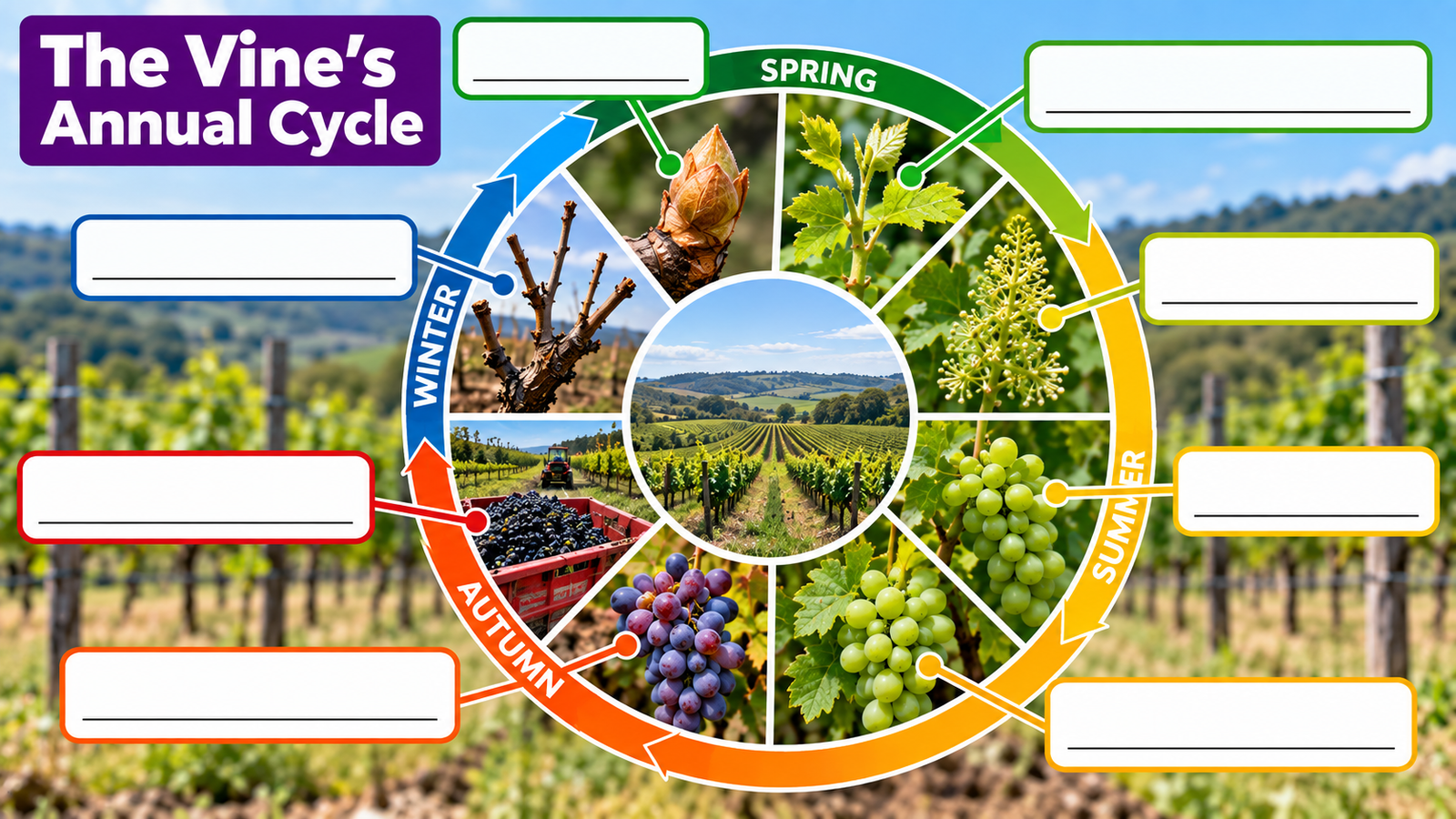
🔍 Click image to see answers
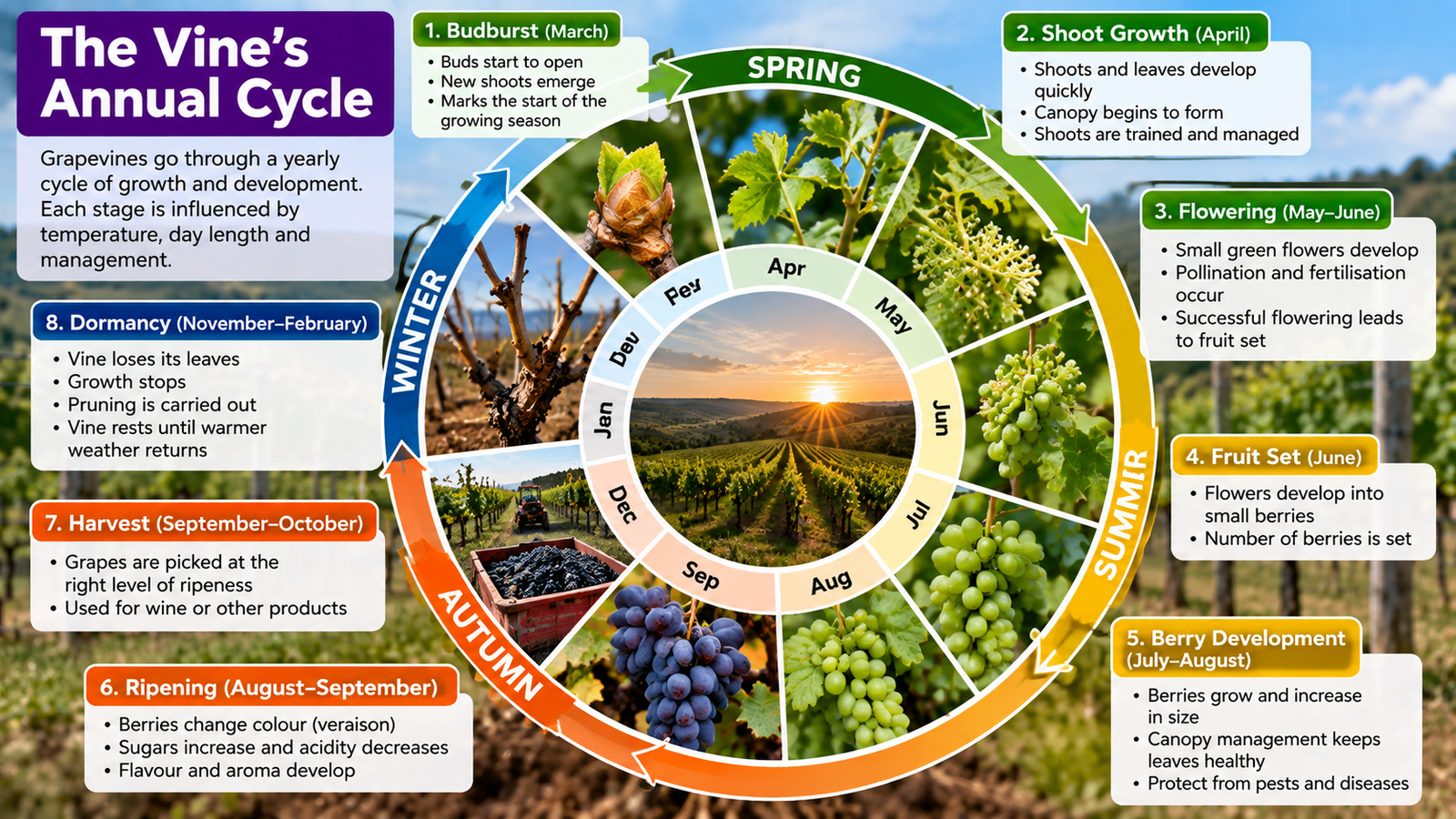
🔄 The Vine’s Annual Cycle
The grapevine moves through a series of recognisable stages:
Dormancy → Budburst → Shoot Growth → Flowering → Fruit Set → Berry Development → Veraison → Ripening → Dormancy
These stages overlap rather than occurring as completely separate events.
For example, while berries are developing, the vine is also producing and managing a canopy. This means several biological processes are happening at the same time.
🌿 The annual cycle at a glance
| ❄️ Dormancy | Vine is inactive; buds remain dormant | Nov–Mar | Pruning, tying, maintenance |
| 🌱 Budburst | Buds break and shoots emerge | Apr | Bud rubbing, frost management |
| 🌿 Shoot growth | Rapid shoot and leaf development | Apr–Jun | Tying, shoot positioning |
| 🌼 Flowering | Flowers develop and pollination occurs | Jun | Canopy management |
| 🍇 Fruit set | Fertilised flowers become young berries | Jun | Canopy management, crop assessment |
| 🟢 Berry development | Berries increase in size | Jun–Aug | Tying, leaf removal, crop management |
| 🟣 Veraison | Berries begin ripening and changing colour | Aug–Sep | Crop monitoring, disease management |
| 🍇 Ripening | Sugar increases and acidity changes | Aug–Oct | Testing, crop monitoring |
| 🚜 Harvest | Grapes are picked when target maturity is reached | Sep–Oct | Harvesting, testing, transport |
| 🍂 Senescence | Leaves age and fall; vine prepares for dormancy | Oct–Nov | Post-harvest monitoring |
*Typical UK timings only. Actual timing can vary considerably between seasons and vineyards.
❄️ 1. Dormancy
During winter, the vine enters a period of dormancy.
The leaves have fallen and visible growth has largely stopped. The vine is conserving resources and surviving the winter rather than producing a crop.
The buds formed during the previous growing season remain on the canes and contain the embryonic shoots and flowers for the following season.
🚜 What happens in the vineyard?
This is an important working period.
Pruning is one of the major winter operations.
The technician must decide:
- which canes to retain
- how many buds to leave
- where fruiting wood will be positioned
- how much growth to remove
- how the chosen pruning system will influence the following season
In the UK, pruning generally takes place through the winter and into early spring.
💡 Think like a technician
Pruning is not simply cutting wood away. It is making decisions about next year’s crop.
🌱 2. Budburst
As temperatures rise in spring, dormant buds begin to develop.
The buds swell and open, and young shoots emerge.
This is called budburst.
It is one of the most important points in the vineyard calendar because the beginning of active growth also brings increased risk from spring frost.
🚜 What happens in the vineyard?
Typical operations include:
- bud rubbing
- monitoring bud development
- frost monitoring
- frost protection
- early pest and disease monitoring
- checking vine health
Bud rubbing removes unwanted shoots developing from unsuitable positions.
⚠️ Why does timing matter?
A frost after budburst can damage young shoots and developing tissues.
The vineyard therefore needs to know:
Where are the vines in their development — and what is the weather likely to do next?
🌿 3. Shoot Growth
Following budburst, shoots develop rapidly.
Leaves expand, shoots elongate and the canopy begins to form.
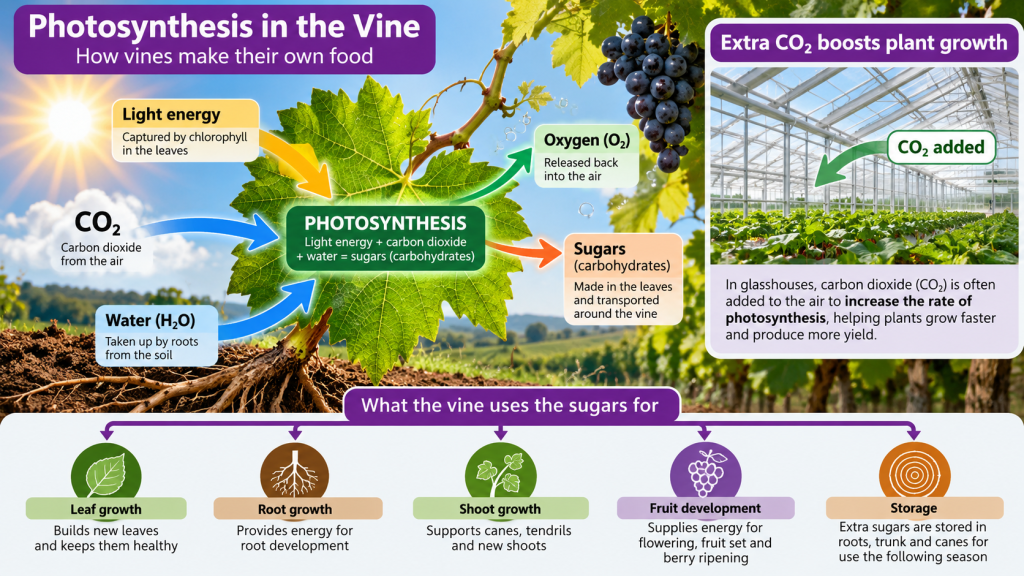
The vine is now capturing sunlight through its leaves and producing carbohydrates through photosynthesis.
The canopy becomes an increasingly important part of vineyard management.
🚜 What happens in the vineyard?
Operations may include:
- shoot positioning
- tying
- canopy management
- removing unwanted shoots
- monitoring growth
- checking for pests and diseases
The aim is not simply to produce more leaves.
The technician is trying to create an appropriate balance between:
Leaf area + light + airflow + fruit + vine structure
🌼 4. Flowering
Small flowers develop within the developing inflorescences.
Grapevines are generally self-pollinating, meaning pollination does not depend on bees visiting each flower.
Successful flowering is important because it provides the opportunity for flowers to develop into berries.
Weather conditions can influence flowering and subsequent fruit set.
🔎 What should the technician monitor?
Look for:
- flowering progress
- poor or uneven flowering
- weather conditions
- vine health
- canopy density
- potential crop variation between blocks
At this stage, the technician is beginning to get a better indication of the potential crop.
🍇 5. Fruit Set
Following successful flowering, fertilised flowers begin developing into young berries.
This is known as fruit set.
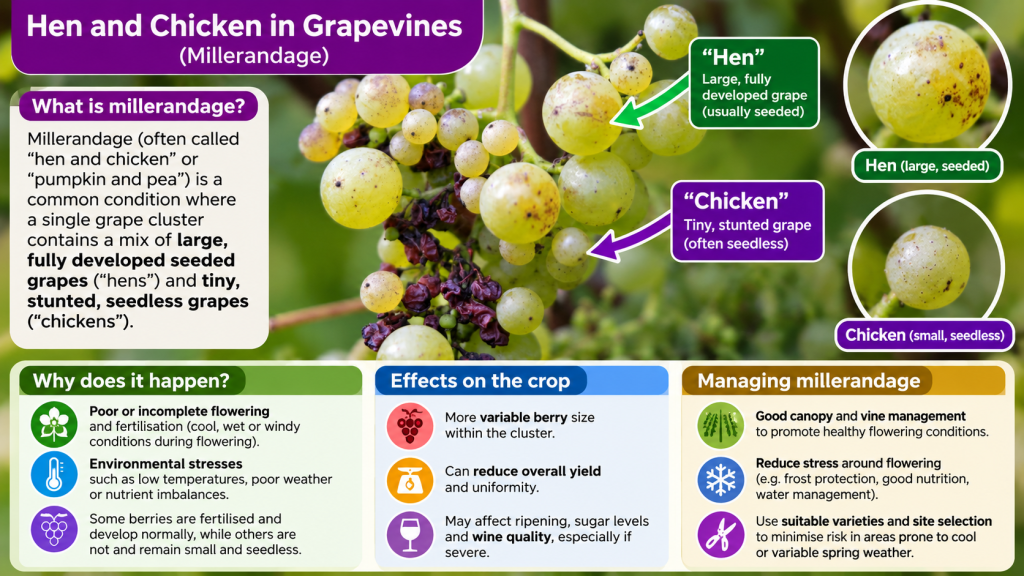
Not every flower necessarily becomes a berry.
The number and development of berries therefore influences the eventual crop.
🚜 Why does this matter?
The technician can begin considering:
How much fruit is developing?
and:
Can the vine and canopy support it?
This leads into the relationship between:
Vine growth → Canopy → Crop load → Fruit quality
🟢 6. Berry Development
Young berries continue to grow and increase in size.
At the same time, shoots and leaves continue developing.
The vineyard can therefore become a very busy workplace.
🚜 Typical operations
Depending on the vineyard and production system, operations may include:
- tying
- shoot positioning
- leaf removal
- canopy management
- crop assessment
- disease monitoring
- weed management
- irrigation where used
- crop-load management
The aim is to maintain a canopy that provides suitable:
Light + airflow + leaf area + fruit exposure
without creating excessive stress or excessive vigour.
🟣 7. Veraison
Veraison means the onset of ripening.
This is a major biological change.
White grape varieties generally become more translucent or change from green towards their mature colour.
Red grape varieties begin developing their characteristic colour.
The berries also begin major changes in their composition.
🍇 What changes?
During ripening:
- sugar concentration increases
- acidity generally decreases
- berry colour develops
- flavour compounds develop
- berry texture changes
- seeds mature
- berry composition changes
This is when the vineyard team moves increasingly towards crop monitoring and harvest preparation.
🍇 8. Ripening
Ripening continues after veraison.
The vineyard team needs to determine when the crop has reached the desired level of maturity.
This is not necessarily simply:
“When are the grapes sweet enough?”
Different grape varieties and wine styles have different requirements.
🔬 What might be tested?
Technicians may monitor:
- sugar level
- acidity
- pH
- berry weight
- flavour development
- colour
- seed maturity
- crop health
This information helps the vineyard make decisions about harvest timing.
🚜 9. Harvest
Harvest is the point where months of vineyard management become a physical crop.
The grapes are removed from the vine and transported for processing.
Harvest timing is a decision based on the condition and maturity of the crop, rather than simply a fixed date on the calendar.
🚜 Harvest decisions can involve:
- crop maturity
- weather forecasts
- disease risk
- variety
- vineyard block
- intended wine style
- available labour or machinery
- processing capacity
This is where biological knowledge becomes a practical management decision.
🍂 10. Senescence and Return to Dormancy
After harvest, the vine does not simply stop.
Leaves remain important because the vine can continue photosynthesis and store resources for the following season.
Eventually the leaves age, change colour and fall.
The vine then returns towards winter dormancy.
And the cycle begins again.
The end of one growing season is already preparing the vine for the next.
🚜 The Annual Cycle = The Vineyard Work Plan
The annual cycle provides a framework for understanding why vineyard jobs happen when they do.
A simplified UK vineyard calendar might look like this:
| Time of year | Vine biology | Vineyard focus |
|---|---|---|
| Nov–Jan | Dormancy | Maintenance and preparation |
| Feb–Mar | Dormancy → pre-budburst | Pruning and tying |
| Apr–May | Budburst → shoot growth | Bud rubbing, frost protection, early canopy work |
| Jun | Shoot growth → flowering → fruit set | Canopy management and crop assessment |
| Jul–Aug | Berry development → veraison | Canopy and crop management |
| Sep–Oct | Ripening → harvest | Testing, harvesting and crop handling |
| Oct–Nov | Post-harvest → senescence | Monitoring, maintenance and preparation |
The dates are guidelines, not rules.
A cold spring may delay budburst.
A warm season may accelerate development.
A particular variety may naturally develop earlier or later than another.
The technician therefore needs to observe the vines rather than blindly follow the calendar.
🧠 Why Does Timing Matter?
A vineyard operation is rarely just about what is done.
It is also about:
When should it be done?
Consider canopy management.
Doing a job:
Too early
The vine may continue growing and undo the work.
At the right stage
The operation can achieve its intended purpose.
Too late
The operation may have less effect or create unnecessary risks.
The same principle applies to:
Pruning → Bud rubbing → Tying → Canopy management → Crop management → Harvest
🔗 Biology → Operation → Outcome
A useful way of thinking like a vineyard technician is:
🌱 Biological stage
What is the vine doing?
↓
🚜 Vineyard operation
What job needs doing?
↓
🎯 Intended outcome
What are we trying to achieve?
For example:
Rapid shoot growth
↓
Shoot positioning / tying
↓
Maintain an organised canopy with suitable light and airflow
🔎 Optional Self-Study
Investigate Grapevine Phenology
Research grapevine phenology and investigate how temperature and weather can influence the timing of vine development.
Find out:
- What is growing degree days (GDD)?
- How can temperature influence budburst?
- Why might two vineyards reach budburst at different times?
- How could a warm spring affect the vineyard calendar?
- Why is frost risk particularly important around budburst?
⭐ Challenge
If spring arrives two weeks earlier than normal, which vineyard operations might also need to change — and why?
Below is presentation which gives more details about Oilseeds grown in the UK.