
Bud Burst

🧠 Build Your Technician Knowledge
- Identify the main stages from budburst to fruit set.
- Explain what happens during flowering, pollination, fertilisation and fruit set.
- Identify how vineyard conditions can affect successful flowering and fruit set
🌦️ Why Spring Weather Matters in UK Vineyards
UK vineyards can experience changeable spring weather. Warm spells may encourage rapid growth, followed by cold nights, rain or strong winds.
The timing of these conditions is important.
| Condition | Possible effect |
|---|---|
| Late spring frost | Damaged shoots and lost crop potential |
| Cold flowering period | Poor flowering and reduced fruit set |
| Prolonged rain | Difficult working conditions and increased disease pressure |
| Strong winds | Shoot damage and physical stress |
| Warm, favourable weather | Rapid shoot growth and flowering development |
See below for Management of these conditions
🤯 Frost: Freezing temperatures can damage young shoots and developing flower clusters.
Vineyards in the UK commonly use passive and active methods to prevent spring frost from damaging tender emerging buds and shoots:
Late and Double Pruning: Delaying the main winter pruning or using double pruning (leaving extra cane length or sacrificial upright canes) exploits apical dominance—meaning basal buds open later, pushing bud-burst past peak spring frost risk windows.
Canopy and Soil Management: Keeping alleyways closely mown and free of tall grass ensures cold air can drain away from lower areas while firm, moist, weed-free soil maximizes daytime heat absorption and night-time radiation back up to the vines.
Active Heating (Frost Candles / Burners): Deploying paraffin or wax frost candles/braziers throughout the rows during cold nights burns fuel to release direct heat and raise the immediate microclimate temperature around the vine base.
The key principle: Good early-season management protects the vine’s potential crop while maintaining healthy growth for the rest of the season.
🌱 Budburst to Fruit Set
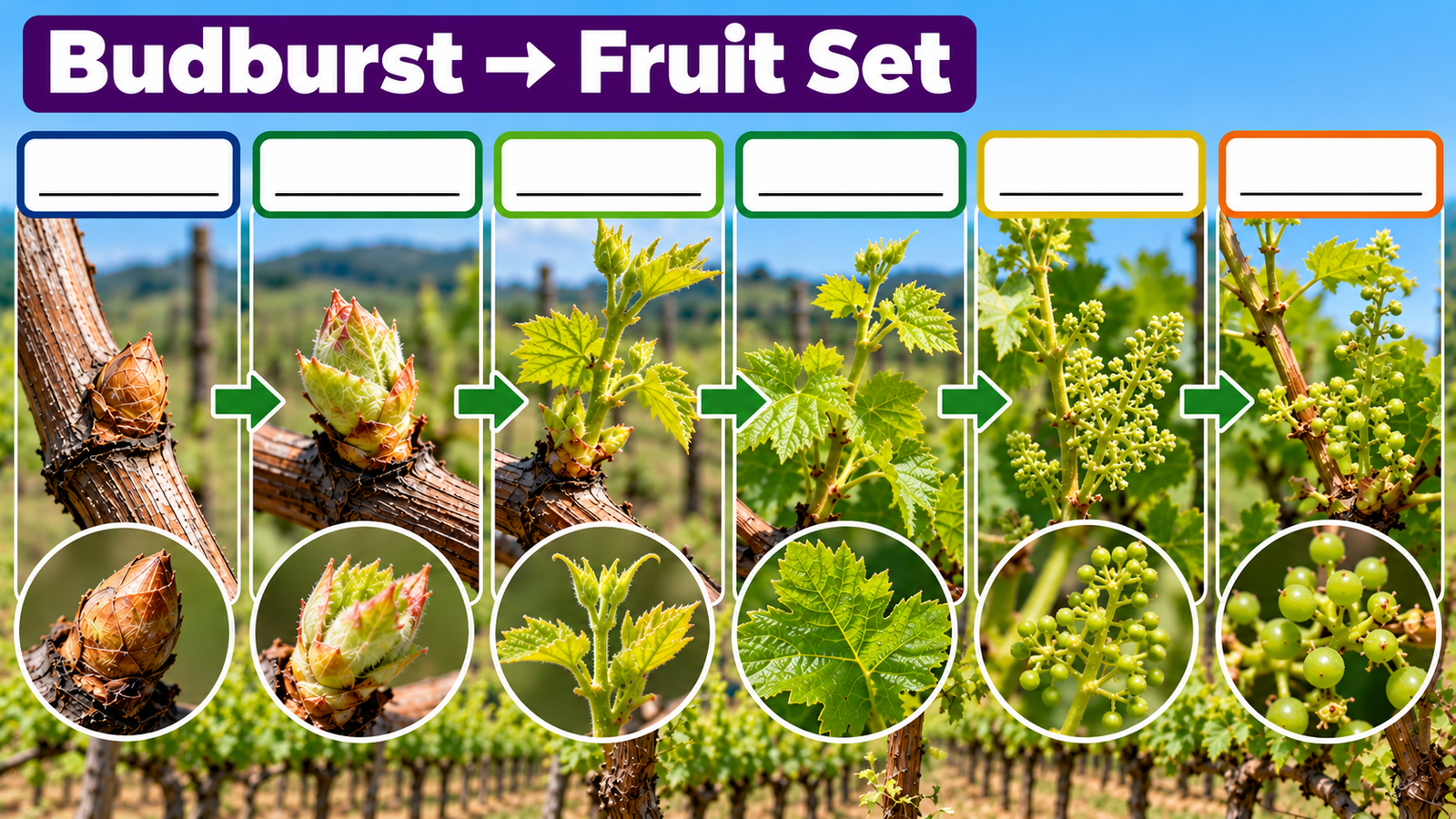
🔍 Click image to see answers
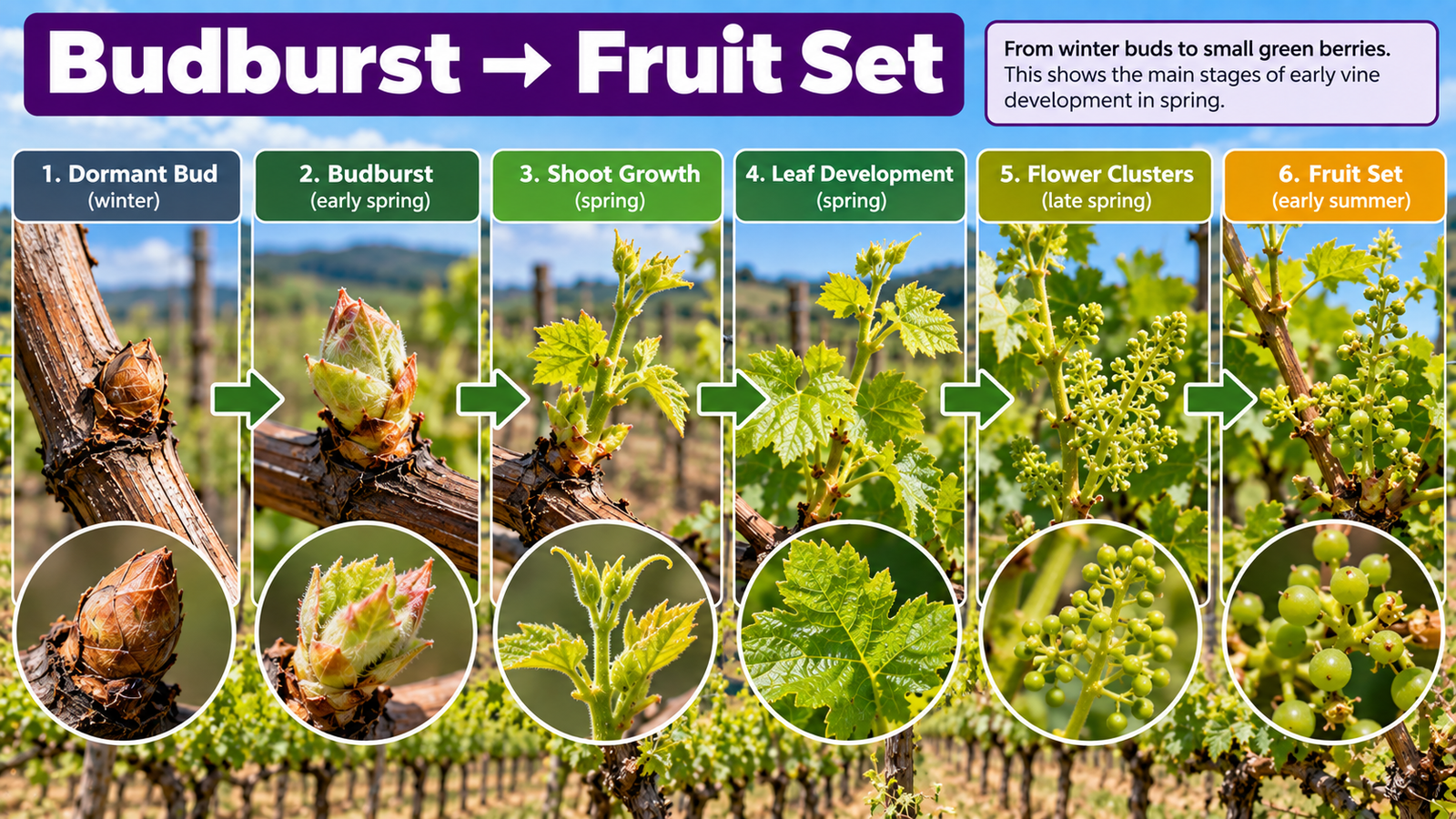
From new shoots to developing grape berries
Understand how a grapevine develops from budburst through flowering to fruit set, and investigate how spring weather and vineyard management affect the potential crop.
🌱 From Budburst to Fruit Set
In spring, grapevines begin a period of rapid growth. Buds open, new shoots develop, and tiny flower clusters form. These flowers must develop successfully before they can produce grapes.
The key stages are:
- Budburst – buds open and new green shoots emerge.
- Shoot growth – shoots extend and leaves develop.
- Inflorescence development – small clusters of flower buds become visible on the shoots.
- Flowering – individual flowers open and become ready for pollination and fertilisation.
- Fruit set – successful flowers begin developing into small grape berries.
Each stage depends on the vine’s health, suitable growing conditions and successful development.
🌿 Shoot Growth and Inflorescences
After budburst, shoots grow rapidly as temperatures rise. New leaves develop and begin photosynthesis, producing sugars that supply energy for growth.
Small flower clusters, called inflorescences, develop on the shoots. These will eventually become grape bunches if flowering and fruit set are successful.
The number of inflorescences and their development help determine the vine’s potential crop.
What affects shoot development?
- Temperature: Warm conditions encourage growth, while cold weather slows it.
- Water: Roots need access to water to support healthy growth.
- Nutrition: Nutrients support leaf, shoot and flower development.
- Frost: Freezing temperatures can damage young shoots and developing flower clusters.
- Vine vigour: Excessive or weak growth can affect canopy development and crop potential.
🌸 Flowering – A Critical Stage
Flowering occurs when the tiny flowers within an inflorescence open. In many grape varieties, the flowers are self-fertile, meaning pollen from the same flower can fertilise it.
Grapevine flowers are unusual because their petals usually remain joined together as a cap. This cap lifts off to expose the reproductive parts of the flower.
Successful flowering requires the reproductive structures to develop and function properly.
Four important terms
- Flowering: The flowers open and their reproductive parts become exposed.
- Pollination: Pollen reaches the receptive stigma of a flower.
- Fertilisation: A sperm cell from the pollen fuses with the egg cell in the ovule.
- Fruit set: Following successful development, the flower’s ovary begins developing into a berry.
These processes are connected, but they are not the same thing.
Remember: Pollination does not automatically guarantee fertilisation or successful fruit set.
🍇 How Does Fruit Set Happen?
After successful fertilisation, the ovary begins to develop into a small green grape berry. The bunch becomes visible as the flowers that have successfully set fruit start to enlarge.
Not every flower produces a berry. Some flowers fail to develop, while others drop off the inflorescence.
The proportion of flowers that develop into berries influences bunch size and the eventual crop.
What can affect fruit set?
Cold conditions
- Can interfere with pollen function and fertilisation.
- May delay flowering and slow vine growth.
Wet weather
- Rain can interfere with flower opening and pollen transfer.
- Prolonged wet conditions can increase disease pressure.
Strong winds
- Can damage tender shoots and make conditions less favourable during flowering.
Excessive vine vigour
- Strong vegetative growth can create a dense canopy.
- Shading and competition for resources can affect reproductive development.
Poor vine health
- Water stress, nutrient imbalances and disease can reduce the vine’s ability to support successful development.
The effects vary with the severity and timing of conditions, grape variety, site and vine health.
🌦️ Why Spring Weather Matters in UK Vineyards
UK vineyards can experience changeable spring weather. Warm spells may encourage rapid growth, followed by cold nights, rain or strong winds.
The timing of these conditions is important.
| Condition | Possible effect | Management priority |
|---|---|---|
| Late spring frost | Damaged shoots and lost crop potential | Monitor forecasts and assess frost risk |
| Cold flowering period | Poor flowering and reduced fruit set | Monitor development and weather |
| Prolonged rain | Difficult working conditions and increased disease pressure | Review disease risk and spray timing |
| Strong winds | Shoot damage and physical stress | Assess exposed sites and vulnerable growth |
| Warm, favourable weather | Rapid shoot growth and flowering development | Keep up with monitoring and canopy work |
Frost: a particular risk
A frost after budburst can kill or damage young green shoots. If a shoot carrying inflorescences is damaged, some of that season’s crop may be lost.
Some vines may produce secondary shoots after damage, but these do not necessarily replace the lost crop potential.
Important: Frost risk depends on site topography, cold-air drainage, weather conditions, vine development stage and the temperature experienced at the vine.
🚜 Early-Season Vineyard Management
Vineyard managers need to balance protecting the developing crop with encouraging healthy, well-positioned shoots.
Bud rubbing
Removing unwanted shoots from the trunk or cordons can reduce congestion and help direct growth towards useful shoots. Timing matters because removing shoots too early or too late can affect labour requirements and vine development.
Frost monitoring
Weather forecasts, vineyard observations and site-specific risk assessments help managers decide whether frost protection measures are appropriate.
Canopy management
As shoots grow, managers may need to position shoots and manage congestion. This helps establish a suitable canopy structure for light penetration, airflow and future crop development.
Disease monitoring
Young growth and developing inflorescences need monitoring for disease risks. Spray decisions should follow vineyard risk assessments, product labels, legal requirements and appropriate integrated pest management principles.
Monitoring vine development
Regular observations help identify differences in growth, frost damage, weak shoots and uneven development between blocks or varieties.
The key principle: Good early-season management protects the vine’s potential crop while maintaining healthy growth for the rest of the season.
Key message: The grapes harvested in autumn depend partly on decisions made in spring. Understanding vine development helps vineyard managers protect crop potential from the very start of the growing season.
Below is presentation which gives more details about Vine Budburst to Fruit Set.