
Bud Burst

🧠 Build Your Technician Knowledge
- Identify the main stages from budburst to fruit set.
- Explain what happens during flowering, pollination, fertilisation and fruit set.
- Identify how vineyard conditions can affect successful flowering and fruit set
🌱 How Does a Vine Feed and Sustain Itself?
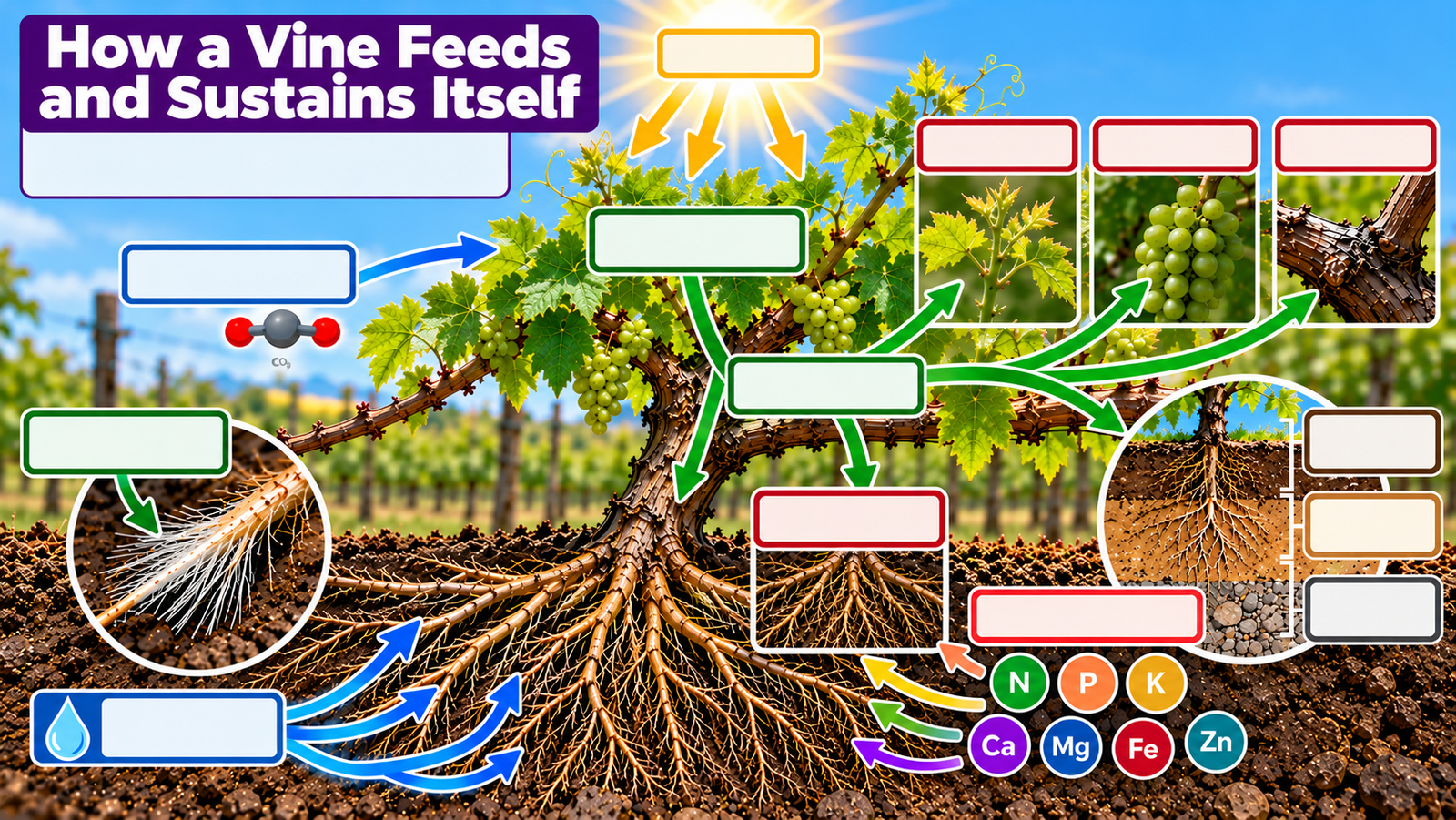
🔍 Click image to see answers
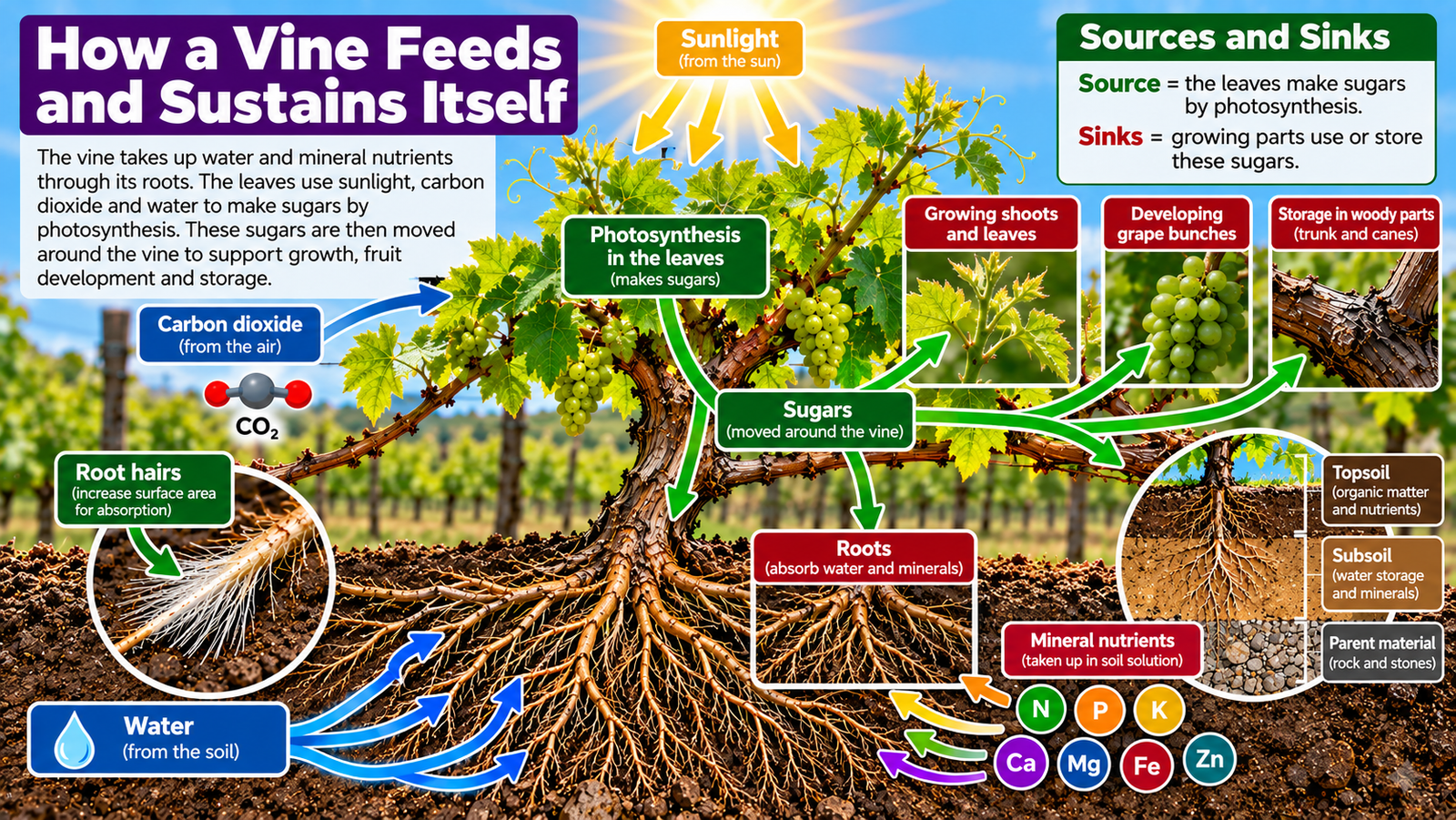
Introduction
A grapevine is a living plant that needs energy, water and nutrients to grow, develop fruit and survive from one growing season to the next.
Unlike animals, vines cannot obtain their food by eating other organisms. Instead, they produce their own sugars through a process called photosynthesis.
The roots, trunk, canes, buds and leaves all have important roles in supporting the growth and development of the vine.
The roots obtain water and mineral nutrients from the soil, while the leaves capture sunlight and use it to produce sugars.
Understanding how these parts work together helps vineyard managers make better decisions about soil management, irrigation, canopy management and grape production.
☀️ 1. How Does Photosynthesis Work?
Photosynthesis is the process by which green plants use light energy to produce sugars.
In grapevines, photosynthesis mainly takes place in the leaves. The leaves contain a green pigment called chlorophyll, which absorbs light energy from the sun.
The vine uses this energy to convert carbon dioxide and water into glucose, releasing oxygen as a by-product.
The photosynthesis equation
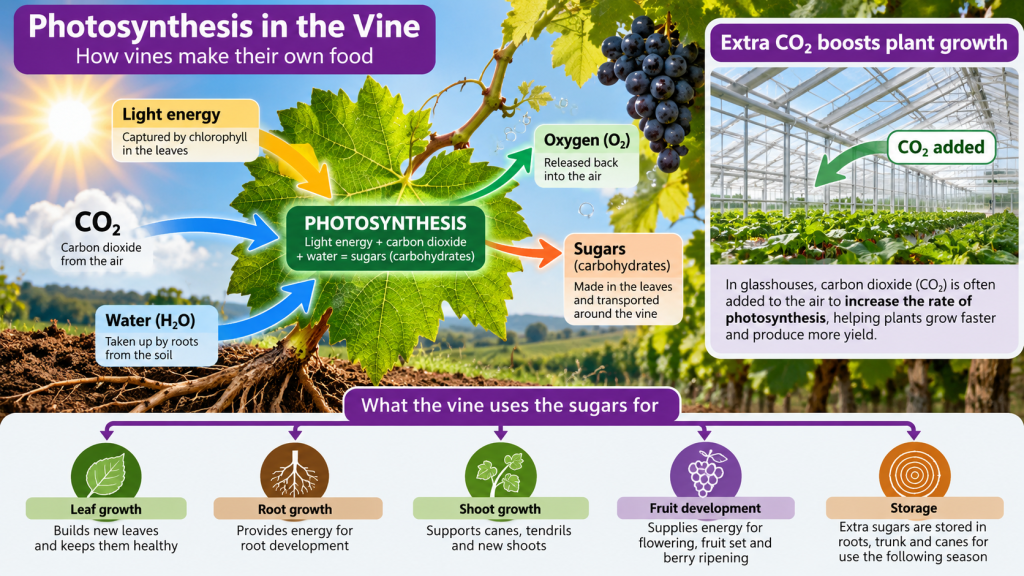
Carbon dioxide + Water + Light energy → Glucose + Oxygen
The simplified chemical equation is:
6CO₂ + 6H₂O + light energy → C₆H₁₂O₆ + 6O₂
Where do the materials come from?
- Carbon dioxide (CO₂): Enters the leaf from the atmosphere through tiny openings called stomata.
- Water (H₂O): Is absorbed by the roots from the soil and transported through the vine.
- Light energy: Comes from the sun and is absorbed by chlorophyll.
- Glucose: Is produced during photosynthesis and provides the building blocks for growth and energy storage.
- Oxygen: Is released into the atmosphere.
The sugars produced through photosynthesis are essential for vine growth and grape development.
A healthy, functioning canopy is therefore important for maintaining an effective supply of sugars throughout the growing season.
🍇 2. What Does the Vine Do With the Sugars It Produces?
The sugars produced during photosynthesis are used in several ways.
Growth
Sugars provide the materials needed to produce new roots, shoots, leaves and other plant tissues.
Grape development
Sugars are transported to the developing grape berries.
As the grapes ripen, sugar accumulation becomes particularly important because it contributes to the potential alcohol content of the finished wine.
Energy
Sugars are used during respiration to release energy needed for the vine’s living processes.
Storage
The vine can store carbohydrates in permanent structures such as the trunk and roots.
These stored reserves help support growth in the following spring, when new shoots and leaves begin developing before the canopy is fully established.
Remember: Photosynthesis produces sugars, but the vine must also transport and use those sugars throughout its different tissues.
🔥 3. Respiration – Releasing Energy
Photosynthesis produces sugars, but the vine needs energy to carry out its living processes.
This energy is released through respiration.
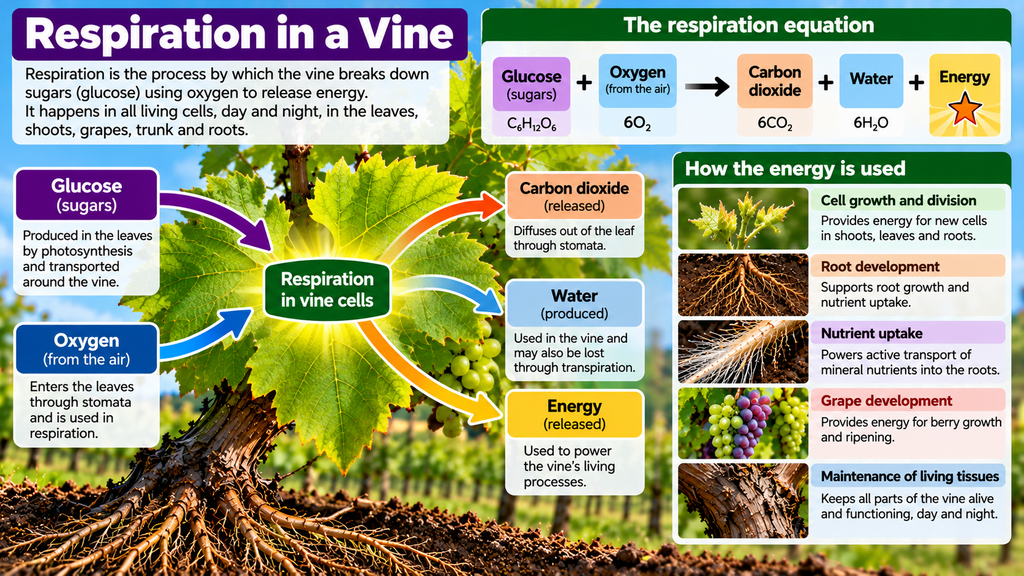
During respiration, glucose is broken down using oxygen. Energy is released, while carbon dioxide and water are produced.
The respiration equation
Glucose + Oxygen → Carbon dioxide + Water + Energy
Respiration occurs in living vine cells, including those in the roots, trunk, shoots, leaves and grapes.
The energy released supports processes such as:
- Cell growth and division.
- Root development.
- Nutrient uptake.
- Maintenance of living tissues.
- Development of shoots and berries.
Respiration takes place during both the day and night.
Photosynthesis requires light, but respiration does not.
This means that a vine continues to use energy even when there is no sunlight.
💧 4. Transpiration – Moving Water Through the Vine.
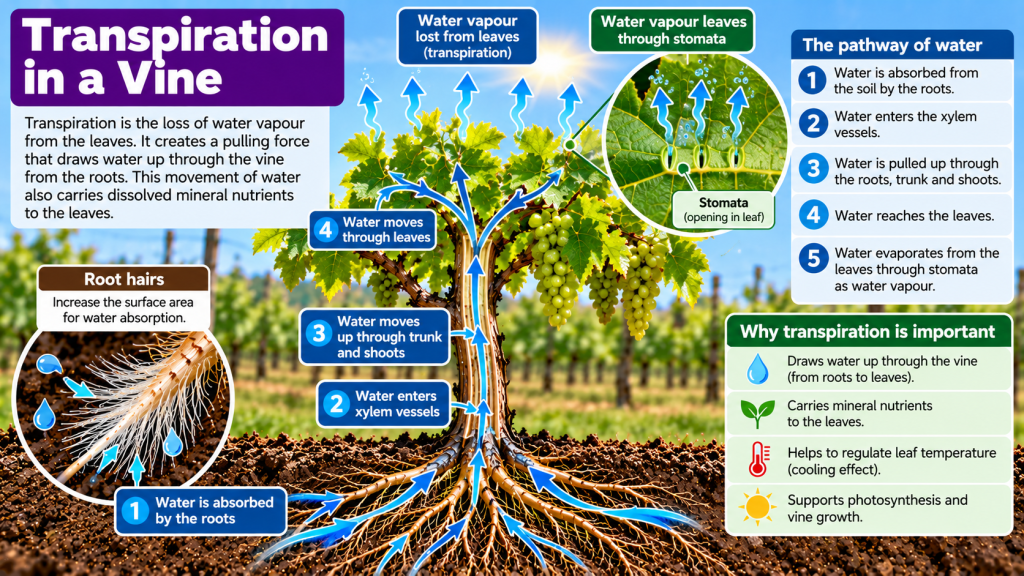
Transpiration is the loss of water vapour from the plant, mainly through the stomata in the leaves.
As water evaporates from the leaf, it creates a pulling force that helps draw more water up through the vine.
This movement of water is important because it transports dissolved mineral nutrients from the soil towards the growing parts of the plant.
Transpiration also helps regulate leaf temperature.
How does water move through a vine?
- How does water move through a vine?
- Water is absorbed from the soil by the roots.
- Water enters the xylem vessels.
- Water moves upwards through the roots, trunk and shoots.
- Water reaches the leaves.
- Water vapour is released through the stomata.
The xylem is the plant tissue responsible for transporting water and dissolved minerals.
What happens during drought?
When soil water becomes limited, the vine may close its stomata to reduce water loss.
However, closing the stomata also reduces the amount of carbon dioxide entering the leaves.
This can reduce photosynthesis and therefore limit sugar production.
This is an important relationship between water availability, photosynthesis and grape development.
🌳 5. The Grapevine Root System
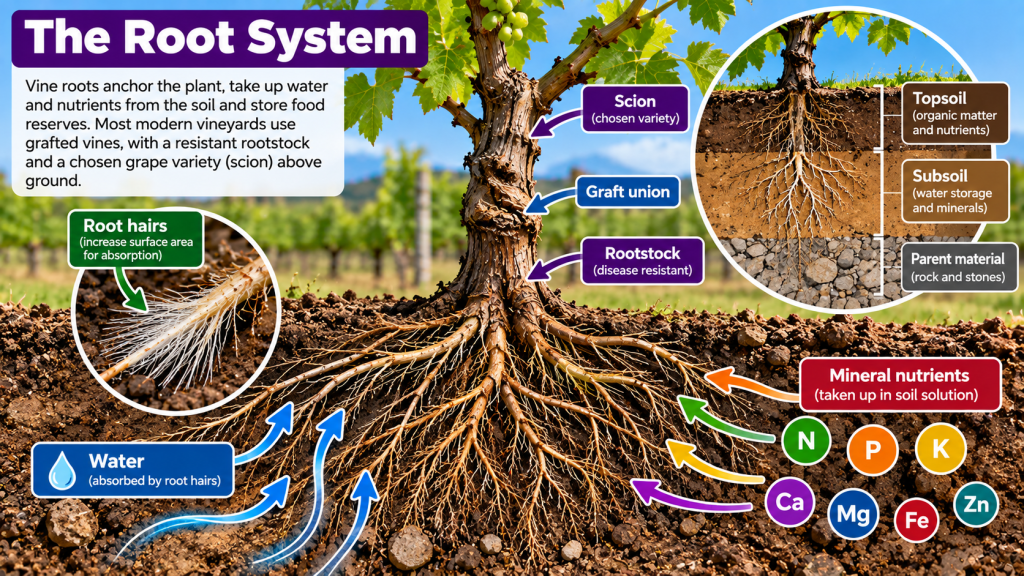
The root system is essential for the survival and performance of the vine.
Although roots are hidden beneath the soil, they have a major influence on the growth of the above-ground parts of the plant.
Main functions of grapevine roots
Water uptake
Roots absorb water from the soil, supplying the vine with the water needed for photosynthesis, transpiration and other physiological processes.
Nutrient uptake
Roots absorb mineral nutrients such as nitrogen, phosphorus, potassium, magnesium and calcium.
These nutrients are required for healthy growth and development.
Anchorage
The root system helps secure the vine in the soil, supporting the trunk and canopy.
Storage
Roots can store carbohydrates and other reserves that help support the vine during dormancy and early spring growth.
Interaction with soil organisms
Roots interact with soil microorganisms, including beneficial fungi and bacteria. These relationships can influence nutrient availability and root function.
🌱 6. How Do Roots Obtain Water and Nutrients?
Roots absorb water and nutrients from the soil surrounding them.
The soil provides a combination of mineral particles, organic matter, water and air.
Healthy root development depends on suitable soil conditions.
Soil structure
Well-structured soil allows roots to grow through the soil profile and explore a larger volume of soil.
Compacted soil can restrict root growth and reduce the movement of water and air.
Soil moisture
Roots need access to water, but excessive water can also cause problems.
Waterlogged soils may contain insufficient oxygen for healthy root respiration.
This can reduce root activity and affect the ability of the vine to absorb water and nutrients.
Soil nutrients
Mineral nutrients are required for healthy vine development.
Nutrient deficiencies can reduce growth, leaf function and fruit development.
However, excessive nutrient availability can also create problems.
For example, excessive nitrogen may encourage vigorous vegetative growth, producing dense canopies that shade the fruiting zone.
Soil depth
Deep soils may provide a larger volume of soil for root development and water storage.
Shallow soils may restrict rooting depth and increase the risk of water stress.
The actual response will depend on soil type, drainage, climate, rootstock and vineyard management.
🍇 7. Rootstocks – Why Are They Important?
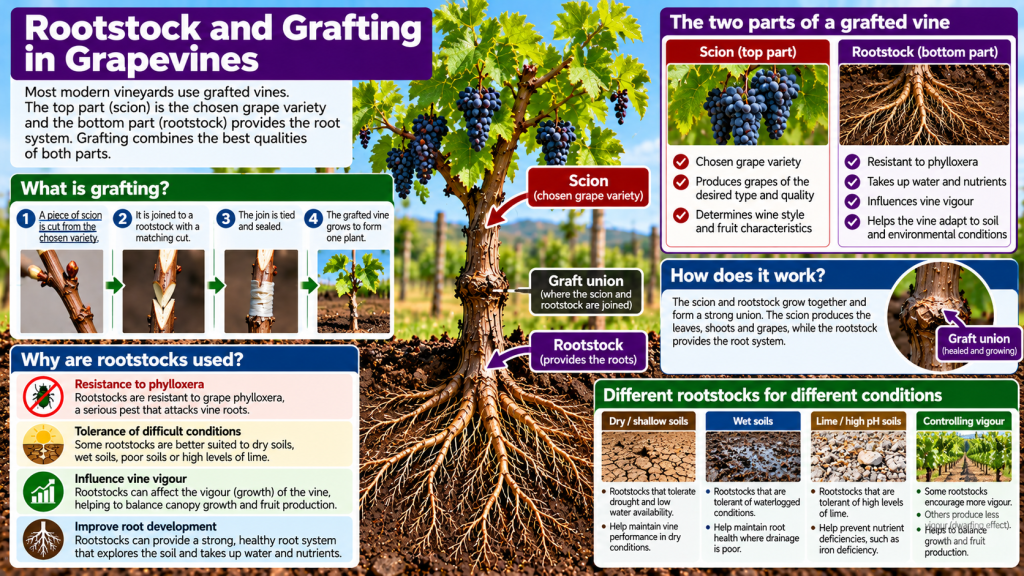
Many commercial grapevines are grafted.
The upper part of the vine, known as the scion, is the grape variety selected for fruit production.
The lower part is the rootstock, which provides the root system.
Rootstocks are commonly used because of their resistance to grape phylloxera, a serious pest that damages grapevine roots.
Rootstock selection can also influence:
- Vine vigour.
- Water uptake.
- Nutrient uptake.
- Tolerance of certain soil conditions.
- Adaptation to drought or other environmental stresses.
Different rootstocks perform differently depending on the vineyard site.
For example, a rootstock selected for a dry, shallow soil may not be the best choice for a deep, fertile soil.
Rootstock selection is therefore an important part of vineyard establishment and long-term management.
🌿 8. How Do Roots and Leaves Work Together?
The roots and leaves are closely connected.
The roots supply the vine with water and mineral nutrients.
The leaves use water, carbon dioxide and light energy to produce sugars through photosynthesis.
These sugars are transported to other parts of the vine, including the roots, shoots, trunk and developing grapes.
This relationship is essential for maintaining vine growth and fruit production.
A problem affecting one part of the vine can therefore influence the performance of the whole plant.
Example: A vine growing in compacted soil
Compacted soil may restrict root development.
This can reduce the volume of soil explored by the roots and limit access to water and nutrients.
If water uptake becomes restricted, the vine may experience water stress.
Water stress can lead to stomatal closure, reducing carbon dioxide uptake and photosynthesis.
The vine may then produce fewer sugars to support growth and grape development.
This demonstrates why soil management is directly linked to canopy performance and fruit production.
🚜 9. Vineyard Management – Maintaining a Healthy Vine
Understanding vine biology helps growers make informed management decisions.
Soil management
Maintaining suitable soil structure can support root development, water movement and soil aeration.
Avoiding unnecessary compaction is particularly important in vineyards where machinery operates between rows.
Irrigation and water management
Where irrigation is available, water management should aim to maintain suitable vine water status.
The amount and timing of irrigation will depend on soil conditions, weather, vine development and the production objectives of the vineyard.
Canopy management
Canopy management aims to maintain a suitable balance between vegetative growth and fruit production.
Practices such as shoot positioning, topping and selective leaf removal can influence light interception, airflow and the distribution of the canopy.
Disease management
Healthy leaves are important for photosynthesis.
Monitoring and managing diseases that damage the canopy helps maintain effective leaf area.
Nutrient management
Nutrient applications should be based on the needs of the vine and the conditions of the vineyard.
Excessive nutrient application may encourage unwanted growth, while deficiencies can limit vine performance.
Remember: The roots and leaves are not separate systems. They work together to support the growth, development and survival of the vine.
Below is presentation which gives more details about Vine Budburst to Fruit Set.