
🧠 Build Your Technician Knowledge
- Explain explain how canopy management changes the environment around vine and fruit.
- Analyse a canopy for density, airflow, light interception and crop load
- Evaluate a canopy decision using growth, fruit exposure, disease risk and grape quality.
Westover Viticulture – Canopy Management
🌱 How is crop canopy managed?
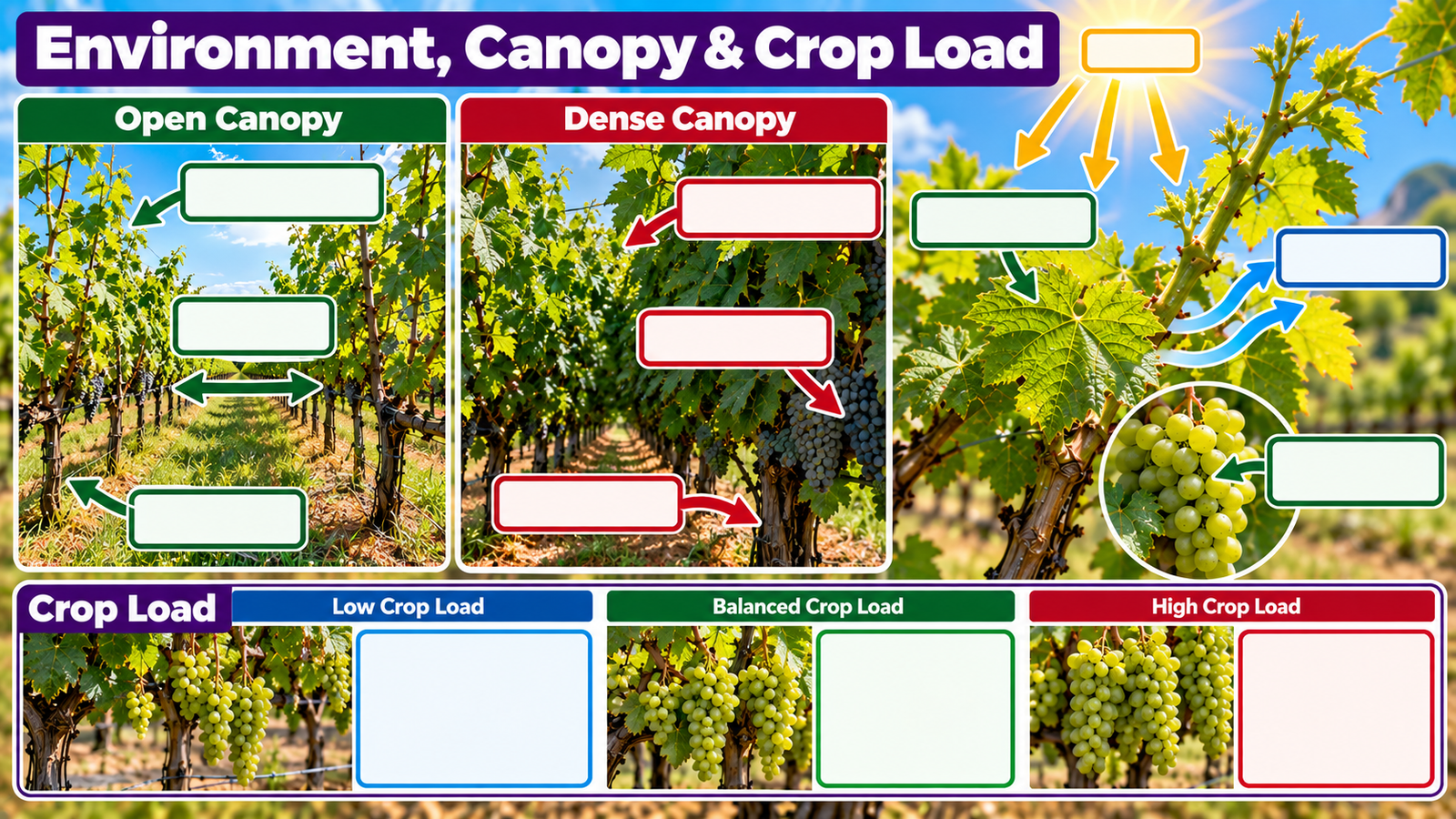
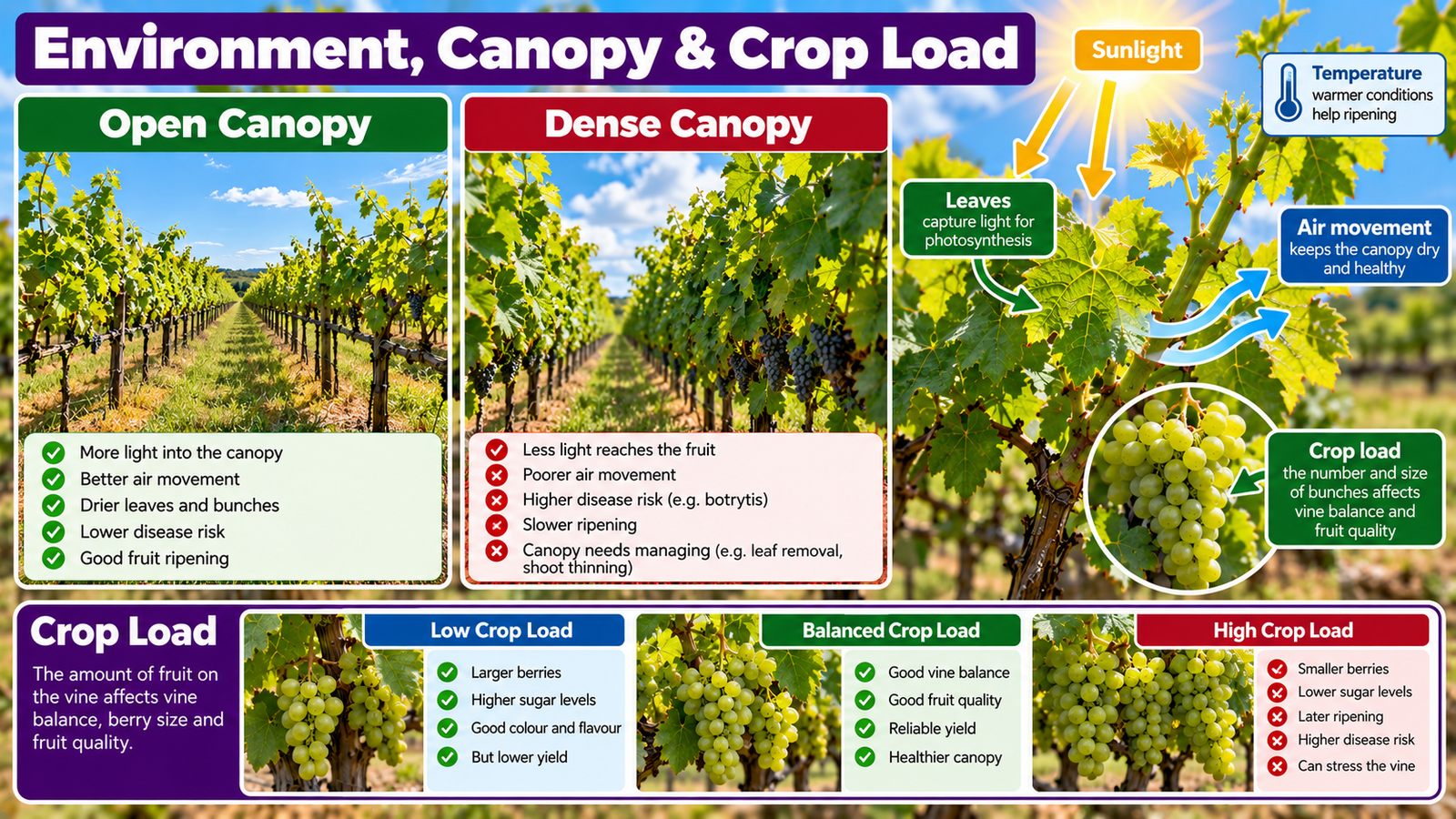
🔍 Click image to see answers
Introduction – Managing the vine’s growing environment
A vine is a living biological system. Its growth and development are influenced by the conditions around it, including sunlight, temperature, water availability, wind and frost.
The grower cannot control the weather, but they can influence the environment immediately surrounding the vine.
This is where canopy management becomes important.
Canopy management involves controlling the growth and arrangement of shoots, leaves and fruit to create the best possible conditions for healthy vine development and grape production.
The aim is to achieve a balance between:
- Sufficient leaf area to support photosynthesis.
- Good sunlight penetration throughout the canopy.
- Adequate airflow to reduce disease pressure.
- Suitable fruit exposure for ripening.
- A manageable crop load that the vine can support.
Think about it: A vine covered in leaves might look healthy and vigorous, but does that necessarily mean it will produce the best grapes?
1. The Vineyard Environment 🌤️
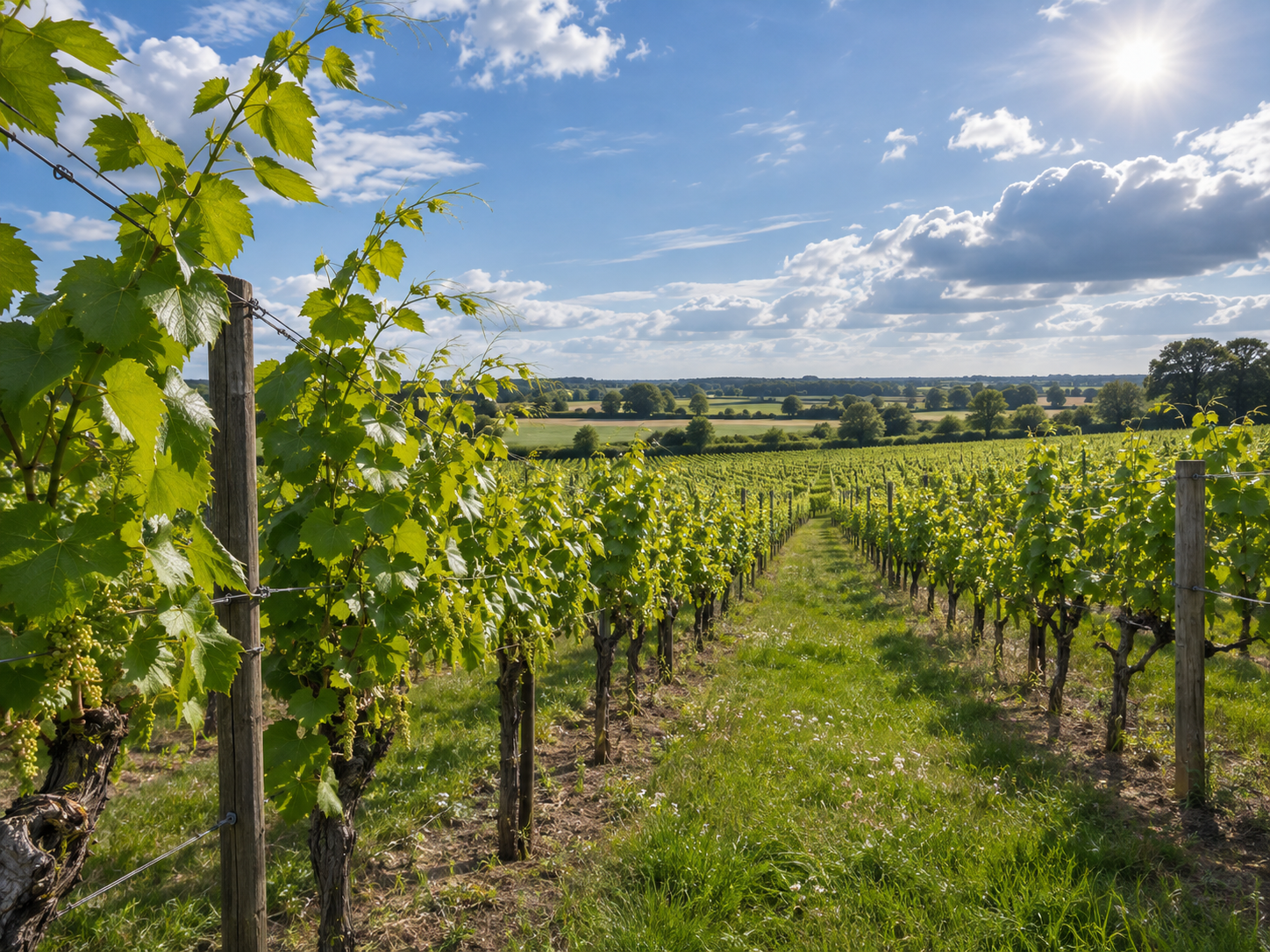
Vines respond continuously to their environment. Different environmental conditions influence growth, flowering, fruit development, ripening and ultimately grape quality.
The five key environmental factors
1. Light ☀️
- Provides the energy required for photosynthesis.
- Influences sugar production and fruit ripening.
- Helps develop grape colour and flavour compounds.
- Poor light penetration can result in shaded leaves and fruit.
2. Temperature 🌡️
- Influences the rate of photosynthesis and respiration.
- Controls the speed of budburst and shoot development.
- Affects flowering, fruit set and ripening.
- Excessive heat can cause berry sunburn and reduce vine activity.
3. Water 💧
- Required for photosynthesis and nutrient transport.
- Maintains cell turgor and shoot growth.
- Water stress can restrict shoot development and berry growth.
- Excessive water availability can encourage excessive vegetative growth.
4. Wind 💨
- Can help dry leaves and bunches after rainfall.
- Reduces humidity within the canopy.
- Strong winds can damage shoots and break young growth.
- Can increase water loss through transpiration.
5. Frost ❄️
- Spring frost can damage newly emerging shoots.
- Flowers and young bunches may be damaged by freezing temperatures.
- Frost risk is influenced by topography, air movement and vineyard location.
- Damage can significantly reduce crop potential.
The grower needs to understand how these factors interact. For example, a wet growing season combined with a dense canopy can create conditions favourable for fungal diseases.
2. Understanding the Vine Canopy 🌿
The canopy is the above-ground vegetative growth of the vine. It consists mainly of:
- Shoots – the growing stems that develop from buds.
- Leaves – the main sites of photosynthesis.
- Lateral shoots – secondary shoots growing from leaf axils.
- Tendrils – structures that help the vine attach to its support.
- Bunches – the developing grape crop.
The canopy performs several important functions:
- Captures sunlight for photosynthesis.
- Produces carbohydrates to support growth and fruit development.
- Provides the leaf area needed to sustain the crop.
- Influences the temperature, humidity and airflow around grape bunches.
- Protects developing grapes from excessive sunlight and heat.
Why does canopy structure matter?
A vine needs enough leaves to produce the energy required to ripen its grapes. However, too much vegetative growth can create a dense canopy.
This creates a management challenge.
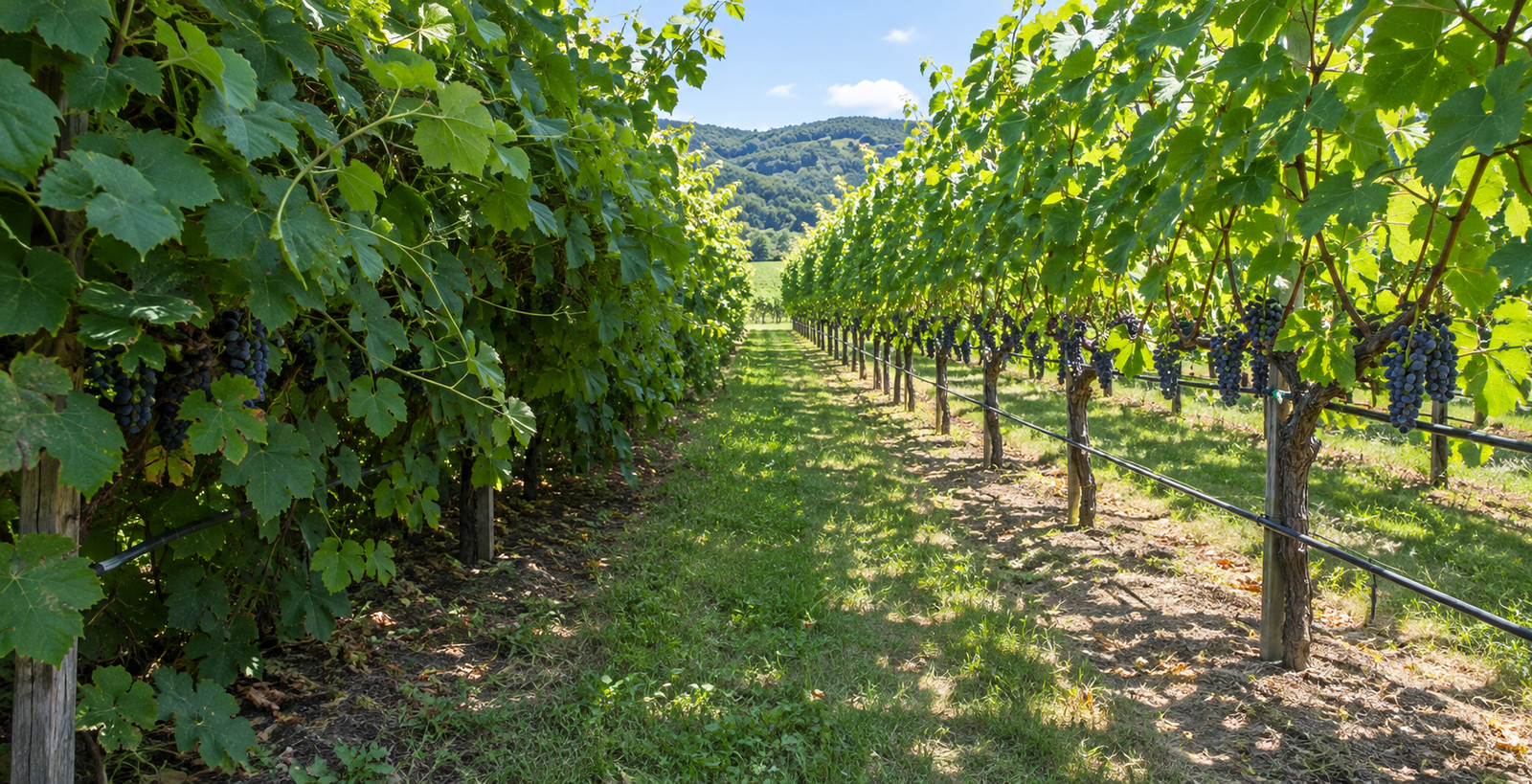
A dense canopy can result in:
- Reduced airflow.
- Shaded leaves and bunches.
- Increased humidity.
- Greater disease risk.
- Poor light distribution.
A well-managed canopy can provide:
- Improved airflow.
- Better light distribution.
- Easier crop inspection.
- More accessible bunches.
- Better drying conditions following rainfall.
An open canopy is not automatically a good canopy. Excessive leaf removal can expose grapes to too much direct sunlight, causing sunburn and excessive berry temperatures.
The objective is balance, not simply removing as many leaves as possible.
3. Canopy Management Operations ✂️
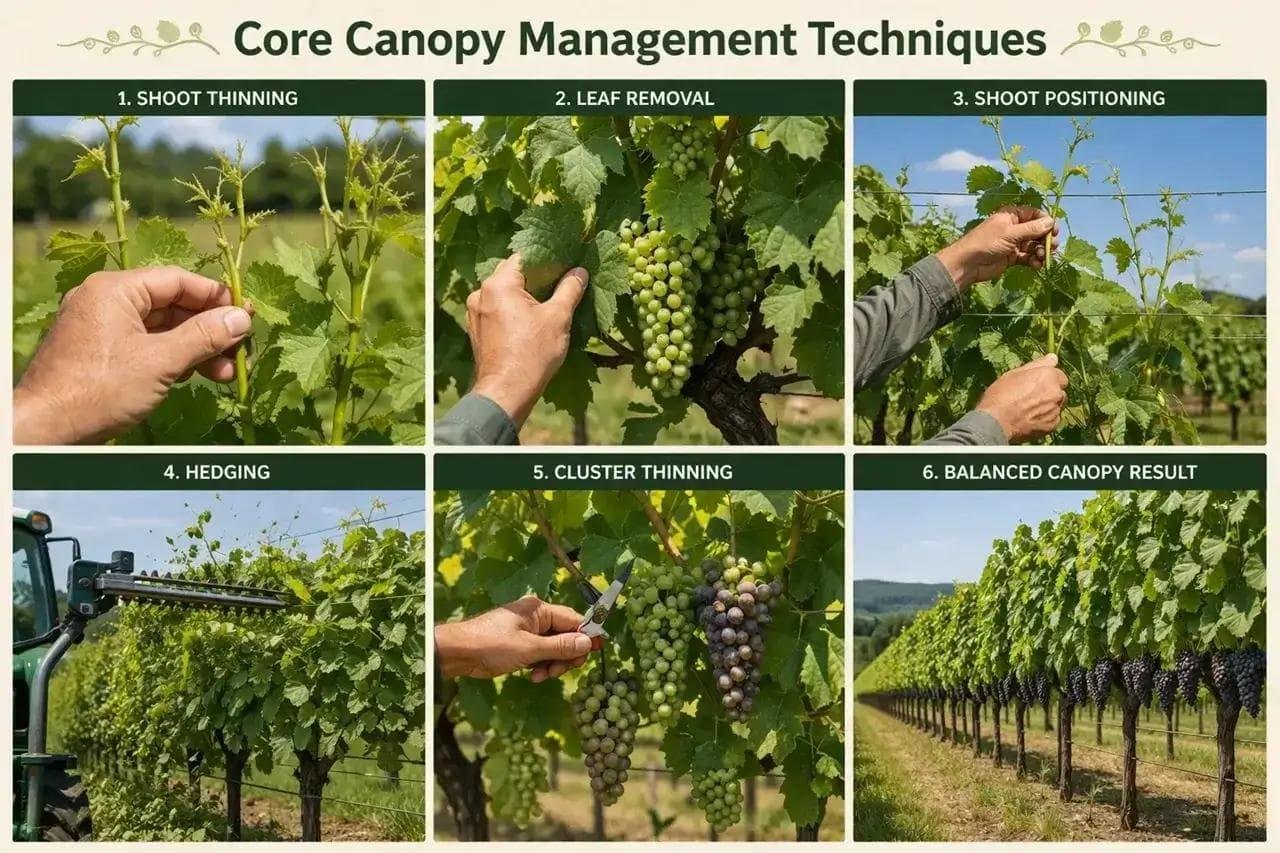
Canopy management involves a range of practical operations carried out throughout the growing season.
Each operation changes the structure of the canopy and influences the conditions around the fruit.
A. Shoot Positioning and Tucking
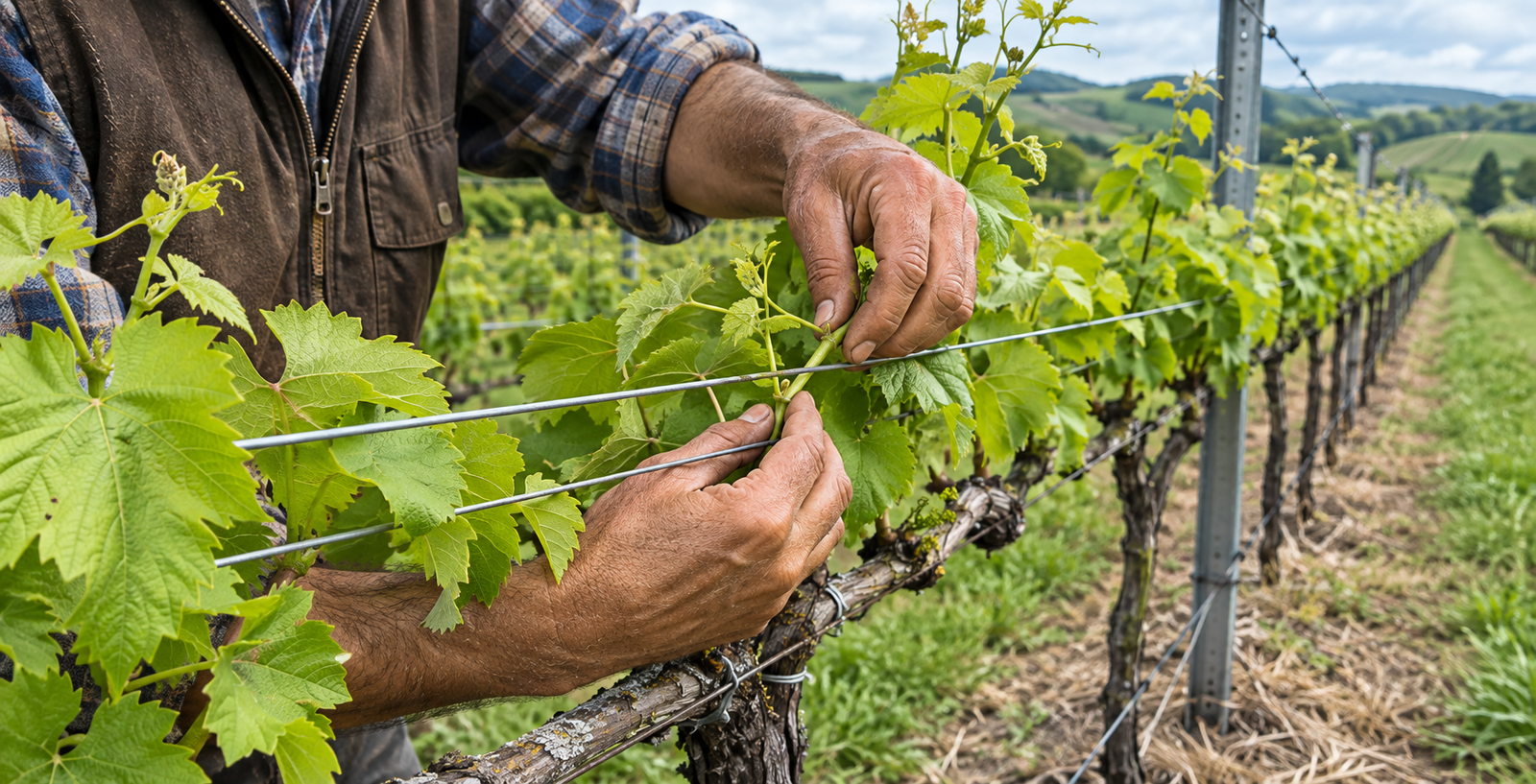
Shoots are guided and secured within the trellis wires to maintain an organised canopy.
Why is it done?
- Keeps shoots upright and organised.
- Improves light distribution.
- Helps maintain airflow.
- Prevents shoots interfering with machinery and vineyard operations.
Technician consideration: When should shoots be positioned to avoid damage and excessive tangling?
B. Topping and Trimming
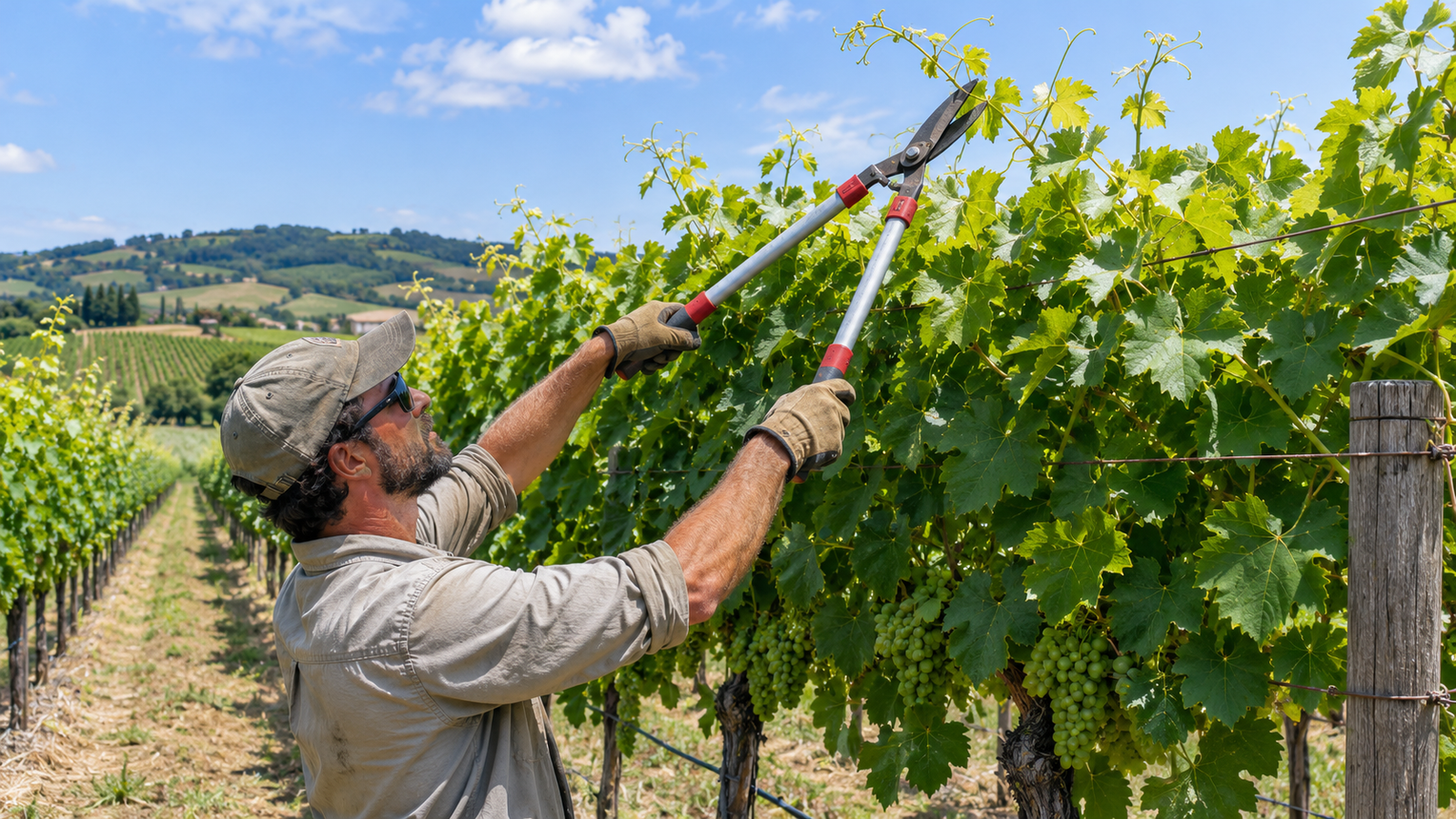
Excessive shoot growth is removed to maintain canopy height and shape.
Why is it done?
- Controls excessive shoot extension.
- Maintains access between rows.
- Prevents shoots becoming difficult to manage.
- Maintains the intended canopy structure.
Technician consideration: Excessive or poorly timed trimming can stimulate lateral growth and remove useful leaf area.
C. Leaf Removal (De-leafing)
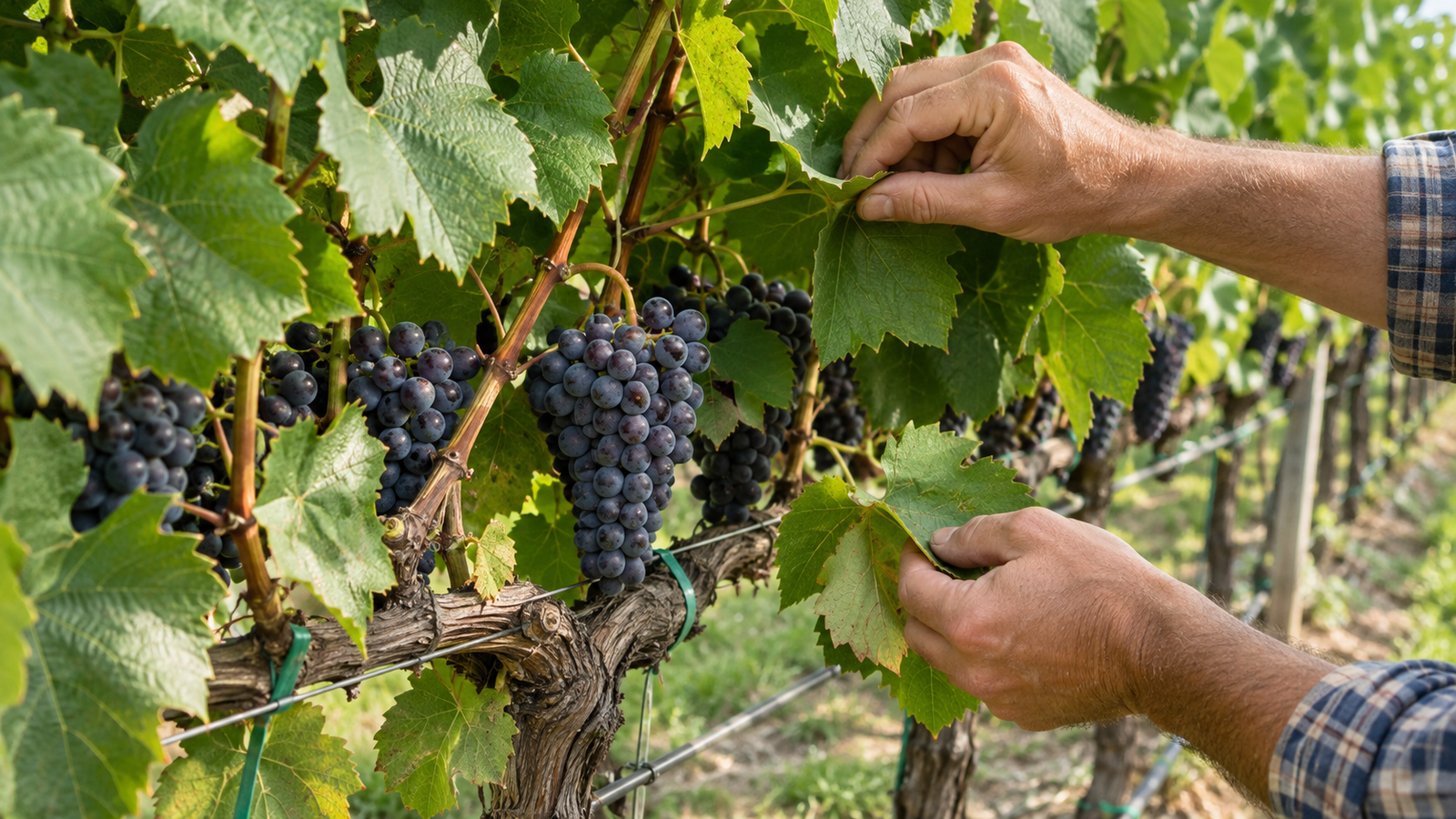
Selected leaves are removed, usually around the fruiting zone.
Why is it done?
- Improves airflow around bunches.
- Allows more light to reach the fruit.
- Helps bunches dry more quickly after rain.
- Can improve spray penetration and disease management.
Technician consideration: Timing and intensity are critical. Early and late leaf removal can have different effects on fruit exposure, berry development and sunburn risk.
D. Lateral Shoot Management
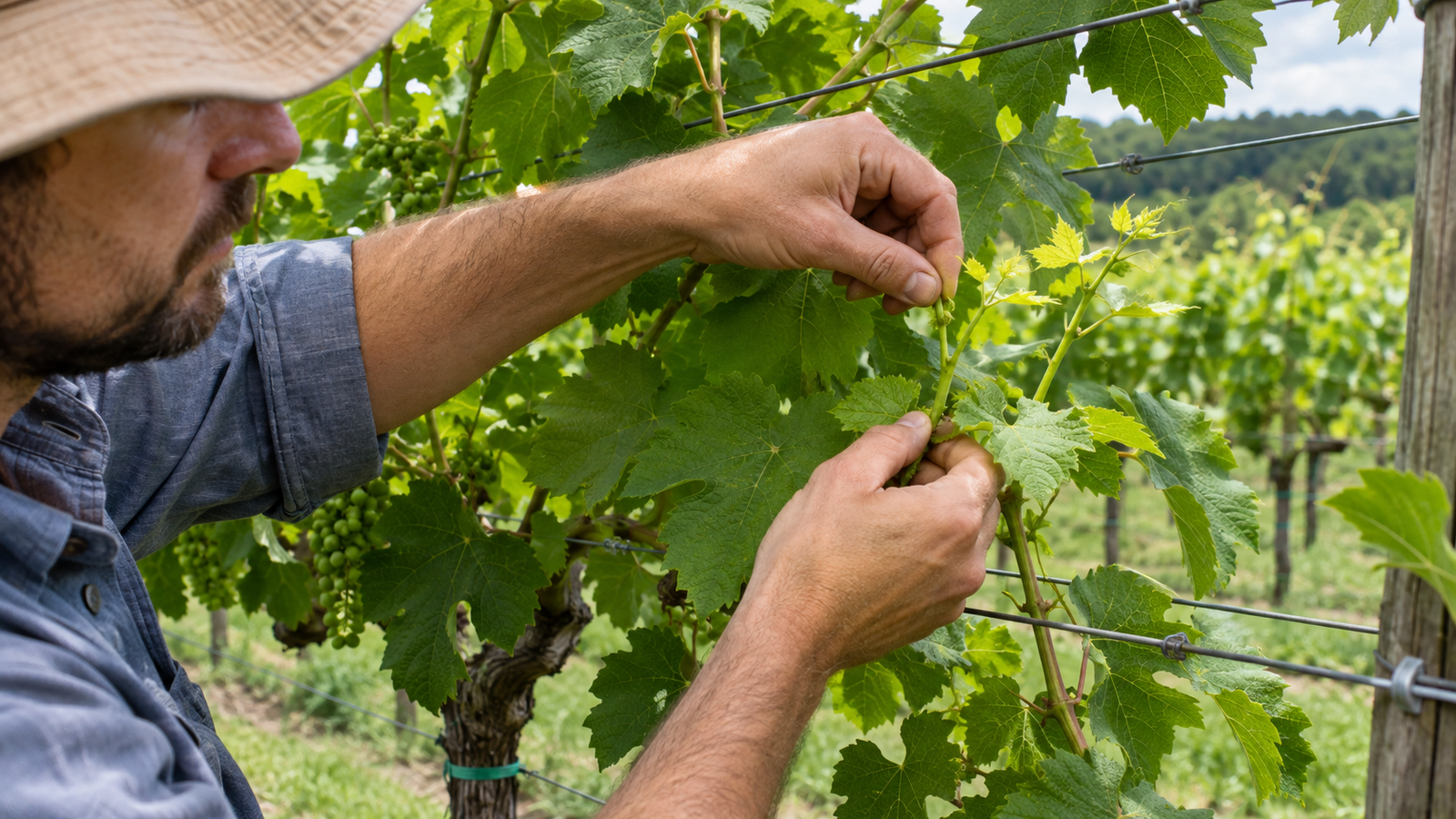
Secondary shoots develop from the leaf axils and can contribute to canopy density.
Why is it done?
- Prevents excessive crowding.
- Helps maintain canopy structure.
- Improves airflow and light distribution.
Technician consideration: Laterals can also provide useful leaf area. Removing them indiscriminately may reduce photosynthetic capacity.
Making Canopy Management Decisions
Consider a vineyard block where the canopy has become excessively dense.
What would you recommend?
- Would you tuck or reposition shoots?
- Would you remove selected leaves?
- Would you trim excessive growth?
- Would you remove lateral shoots?
There is no single answer. The decision depends on vine vigour, growth stage, weather, variety, trellis system and crop condition.
4. Canopy Density, Airflow and Disease Risk 🍃
One of the most important reasons for managing canopy density is disease prevention.
A dense canopy can create a humid microclimate around the developing bunches.
When leaves and bunches remain wet for extended periods, conditions can become favourable for fungal diseases, particularly Botrytis bunch rot (grey mould).
How does canopy density influence disease?
Well-managed canopy:
- Improved air movement.
- Faster drying after rainfall or dew.
- Better spray coverage and penetration.
- Reduced periods of high humidity around bunches.
Dense canopy:
- Restricted airflow.
- Slower drying of leaves and fruit.
- Higher humidity within the fruiting zone.
- Potentially increased Botrytis infection risk.
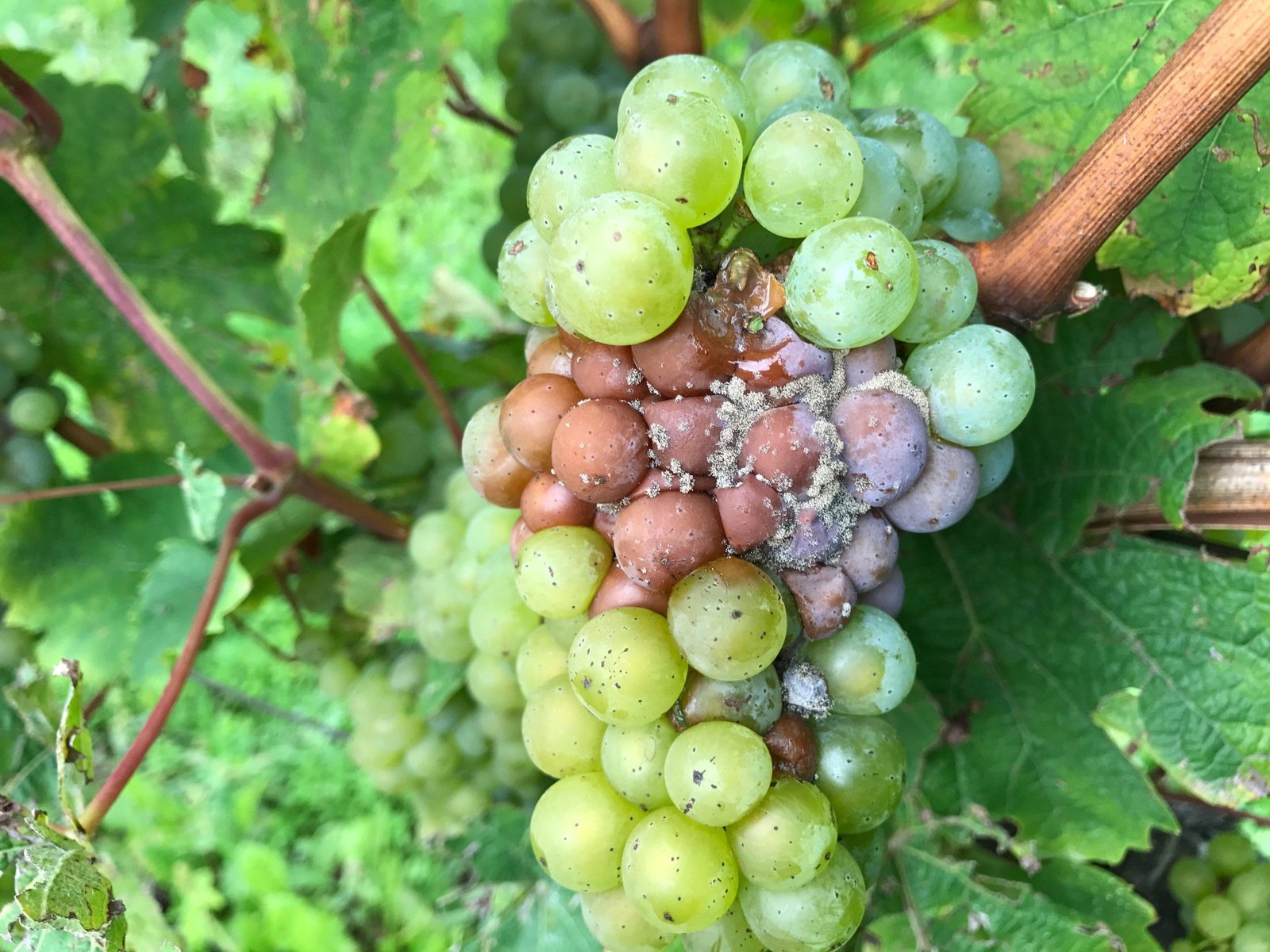
Remember that canopy management reduces favourable conditions for disease; it does not guarantee disease prevention. Variety susceptibility, berry damage, weather and inoculum levels also matter.
5. Understanding Crop Load 🍇
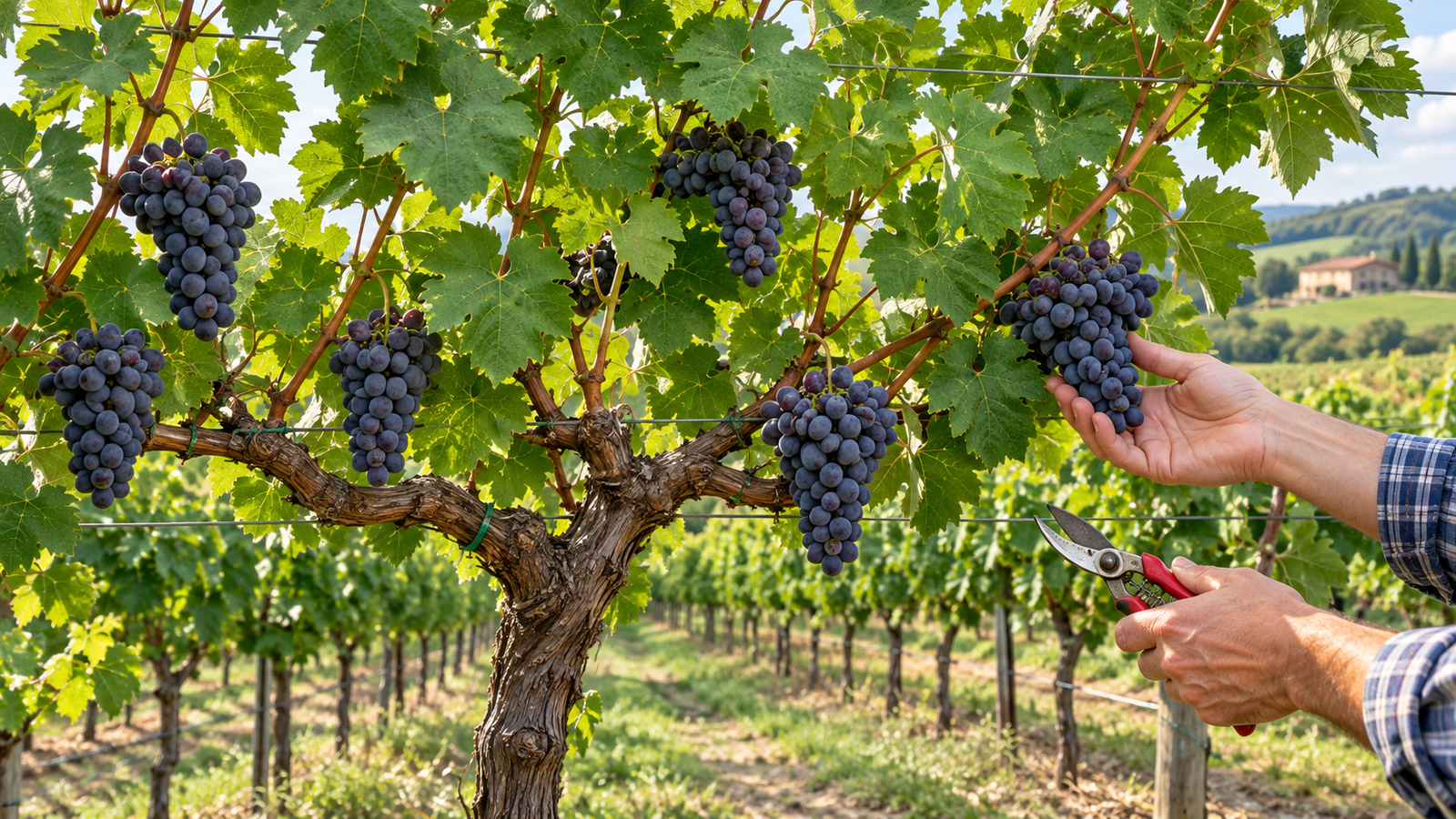
Crop load describes the amount of fruit a vine is expected to produce in relation to its capacity to support and ripen that crop.
A vine has limited resources. Its leaves produce carbohydrates through photosynthesis, while its roots absorb water and nutrients.
These resources must support:
- Shoot and leaf growth.
- Root development.
- Respiration and maintenance.
- Berry development.
- Sugar accumulation and fruit ripening.
- Storage of reserves for the following growing season.
If the crop is too large relative to the vine’s capacity, the vine may struggle to ripen the fruit effectively.
What happens when crop load is unbalanced?
Excessive crop load
- Greater demand for carbohydrates.
- Potentially delayed ripening.
- Lower sugar accumulation at a given date.
- Uneven fruit maturity.
- Reduced replenishment of vine reserves.
Very low crop load
- More resources available per bunch.
- Potential for earlier ripening.
- Greater vegetative growth in some circumstances.
- Potentially reduced yield and economic return.
The objective is not necessarily to produce the maximum number of grapes.
It is to produce a crop that the vine can ripen successfully, while achieving the required yield and fruit quality.
Crop Load Management
Growers can influence crop load through:
- Winter pruning – controlling the number of retained buds.
- Shoot thinning – removing unwanted or excess shoots.
- Bunch thinning – removing selected bunches.
- Canopy management – maintaining sufficient functional leaf area.
- Variety and site selection – matching production potential to local conditions.
A key point: Crop load cannot be considered separately from canopy size and leaf area. The balance between the fruit and the photosynthetic capacity of the vine is important.
6. Evaluating Canopy Management Decisions
There is no universal canopy-management programme that works for every vineyard.
Decisions should be based on the conditions in the individual block.
A technician should consider:
| Factor | Questions to consider |
|---|---|
| Variety | Does the variety naturally produce dense foliage? |
| Vigour | Is shoot growth excessive or restricted? |
| Weather | Has the season been wet, dry, hot or windy? |
| Disease | Is there evidence of disease pressure? |
| Crop load | Can the vine support and ripen the crop? |
| Fruit quality | What characteristics does the intended wine style require? |
| Timing | Is the operation appropriate for the vine’s current growth stage? |
Think Like a Vineyard Technician
The aim is to make informed decisions rather than simply follow a routine.
For example, removing leaves around bunches might improve airflow and reduce disease risk, but carrying out extensive leaf removal immediately before a period of intense sunshine could expose fruit to sunburn.
The technician needs to consider both the benefit and the possible consequences of an operation.
Key Terminology
| Term | Meaning |
|---|---|
| Canopy | The above-ground shoots, leaves and associated growth of a vine |
| Canopy density | How closely packed the shoots and leaves are |
| De-leafing | Removing selected leaves from the canopy |
| Topping | Cutting back excessive shoot growth |
| Shoot positioning | Arranging shoots within the trellis system |
| Lateral shoots | Secondary shoots growing from leaf axils |
| Crop load | The amount of fruit in relation to the vine’s capacity |
| Botrytis | A fungal disease causing grey mould and bunch rot |
| Photosynthetic capacity | The ability of the vine’s leaves to produce carbohydrates |
Below is presentation which gives more details about Vine Budburst to Fruit Set.